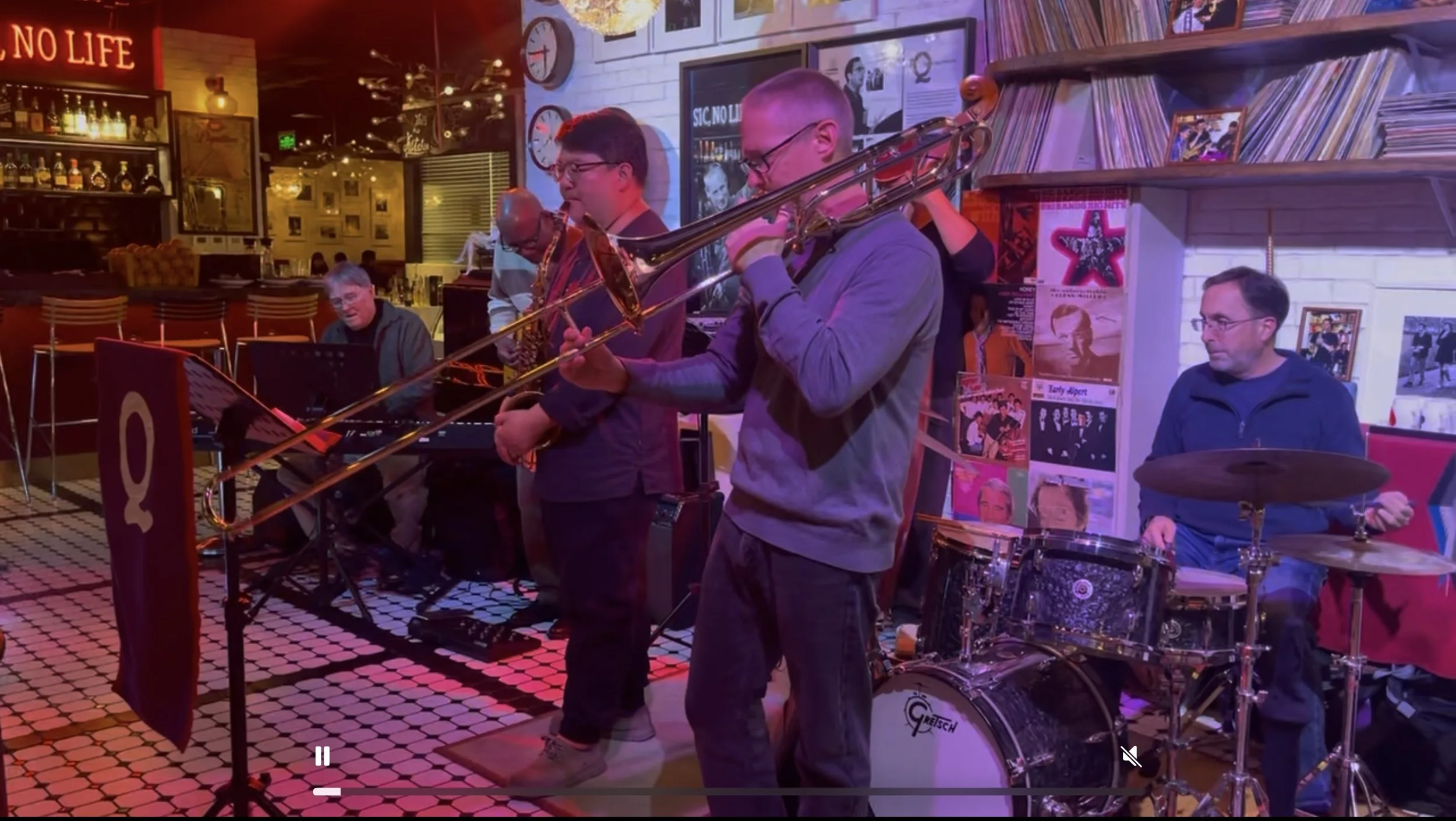
Beijing is kind of a second city for me in China, even though I’ve only lived there for two six-month stints. The first stint was in 1996, when a young PhD candidate from Columbia University came to China on a scholarship to study the Jazz Age of Shanghai, and ended up spending the first six months using the Beijing libraries for his research—and inadvertently, getting a front row seat to the rise of a new sort of Jazz Age in the 1990s. The second stint was in 2007, when a young Chinese history professor based in Sydney took a semester off to run the foreign studies program of his old alma mater, Dartmouth College, and ended up leaving Australia for good and moving to China. People said he was crazy to leave the beaches, harbors, and wines of Sydney--and he kind of was. But here I am, almost twenty years later, still living in China and all the wiser for it.
During the first stint, that plucky young graduate student was lucky to have an old friend from college in town who knew the lay of the land. Well, there were several old college buddies in Beijing, but one named Matt Roberts was helping to spark a jazz movement in the city. I won’t say jazz revival, because until then, Beijing didn’t have much of a history of jazz. Unlike Shanghai, its jazz culture didn’t go back to the 1920s, or if it did there wasn’t much of it. I could be wrong about that, but I don’t recall coming across a lot of references to the Beijing jazz scene while researching the Chinese Jazz Age of the Republican Era. Anyhow, Matt was then and still is a jazz trombonist, and he was working closely with a cadre of young Chinese and American (and other) jazz musicians to build a scene. Back then, there was the CD Café, where rock legend Cui Jian and his partner Liu Yuan played. There wasn’t much else. CD Café was located on the eastern Third Ring Road, and it remained a hotspot for jazz until the 2000s.
During the second stint in 2007, the young professor spent most of his spare time in the rock clubs of the city, but now and then he saw Matt and his band, the Ah Q Jazz Arkestra, who were still playing at the CD Café. There was also a cool spot called East Shore 东岸 on the edge of Shichahai, co-founded by Liu Yuan, which eventually became the leading jazz club in the city. Yet by then, Shanghai was already starting to eclipse Beijing as a center for jazz in China, but that’s another story.
Having based himself in Shanghai since 2008 and immersing himself in the jazz scene of said city, documenting said scene, writing books and making a film about it, said prof has returned to Beijing many times over the years. His/my vision of Beijing is thus a series of snapshots of the city’s development over the past thirty years. And it goes without saying that when visiting the national capital, one focus of my attention continues to be on the city’s music and art scenes—and especially, the jazz scene.
Here is a recap of my latest trip to Beijing, where I spent the past week reconnecting with Matt Roberts and his band Ah Q, while exploring the city’s live music scenes and touching base with its art scene as well.
The call to return to Beijing came when Matt sent me a message that his band Ah Q was holding a new album launch party. He invited me and a former DKU student advisee of mine, Ace Asim, now a student in the prestigious Yenching Academy of Peking University, to attend. Since I’m co-writing an article on the subject of jazz in China for an encyclopedia with my dear old friend and colleague Andreas Steen, it made sense to take a research trip up to Beijing to reengage with the city’s jazz scene and learn more about jazz in Beijing from some of the key players in that scene. But seriously, as a China historian, did I really need an excuse to get back to the national capital? Home of the Forbidden City and the Temple of Heaven, not to mention numerous and sundry other historical and cultural treasures? No, sir, I did not. Still, I did need a catalyst to propel me northward, and Matt’s trombone gave me just the right umphh.
The album launch party would take place in Jianghu Bar in Dongmianhua Hutong near Nanluoguxiang and the Drama Academy. My previous trip to Beijing in 2023 had ended in Jianghu Bar with me playing a rocking set of songs on guitar, followed immediately by a sudden and quite unexpected heart attack and a two-week stint in the Sino-Japanese Friendship Hospital. Since then, I hadn’t been back to the scene of the crime as it were. This was a good opportunity to reconnect with Matt and the band, and to renormalize my relationship with my favorite bar and with the city that had literally saved my life two and half years ago.
Thus, on Sunday morning of December 7, I was on a high-speed train speeding northward to Beijing. The train trip from Shanghai to Beijing used to be an overnight trip back in the day. It was a fun trip, full of memories of hard sleeper and soft sleeper cabins, snoring cabin-mates, and a bottle of whiskey to ease the voyage. Now it’s a 4.5-hour trip up the China coast through river-laced Jiangsu and rolling Shandong Province to the national capital. The snoring persists, but air-pods and a few good tunes keep the snorers at bay.

Andrew on the high speed train from Shanghai to Beijing
For the first half of the week, I chose to stay in the area near the old Drum Tower or Gulou, one of my favorite haunts in the city and a lodestone for the city’s music scenes. It’s no coincidence that the Drum and Bell Towers that once roused the city to action have attracted loads of cafes and bars featuring live music of various sorts. I booked a few nights at an ATour hotel, a budget friendly hotel chain in China. Perhaps a bit TOO budget friendly but I’ll get to that soon. I took the subway from Beijing South Station to the neighborhood, and it was then a 10-minute walk to the hotel, with my guitar and two suitcases--two because I bought one in the Shanghai station after discovering that my small rolling suitcase wasn’t enough for all my winter gear.
This time of year, Beijing gets cold and windy. And I was well prepared for the kind of weather that chaps your lips and roughens your knuckles. Though it was sunny blue-sky weather the first few days, it was still quite cold and blustery, especially at night. I was very glad that I listened to my wife’s wise advice and brought my big Gap winter jacket, which may not look too fashionable these days with its faux fur-lined hood, but it sure kept me plenty warm.
That evening, I walked from the hotel down the block to the Hutong where Jianghu Bar is located. Located along a dark alleyway, the bar itself wouldn’t be easy to find unless you know it, but there is a light in the dark Hutong indicating the door to the bar. Once inside, you find yourself enveloped in a cozy environment, with a glass roof and wooden structures and an inner room with lounge chairs and tables where the stage is located. I’d been in this bar many many times over the years and had even fought for my life in it after belting out my version of Thunder Road by Bruce Springsteen to a late-night crowd in May 2023. A friend called it the “Jianghu curse.” But this night would be different. Matt and the band were getting ready for their performance. I was delighted to find Kent Kedl, an old Shanghaier like me, sitting near the stage with a friend. We were joined by some other Americans who have lived in China for quite some time. As the Chinese say, 物以类聚,人以群分。
Matt and the Ah Q band played a few sets and performed some of their latest songs. Between tunes, Matt spoke as always in fluent Mandarin to the mostly Chinese audience that had crowded into the bar to listen to jazz. And man did they listen. I saw nary a phone in hand, except when people were videoing the performance. There was a lot of rapt attention as the band played its tunes.
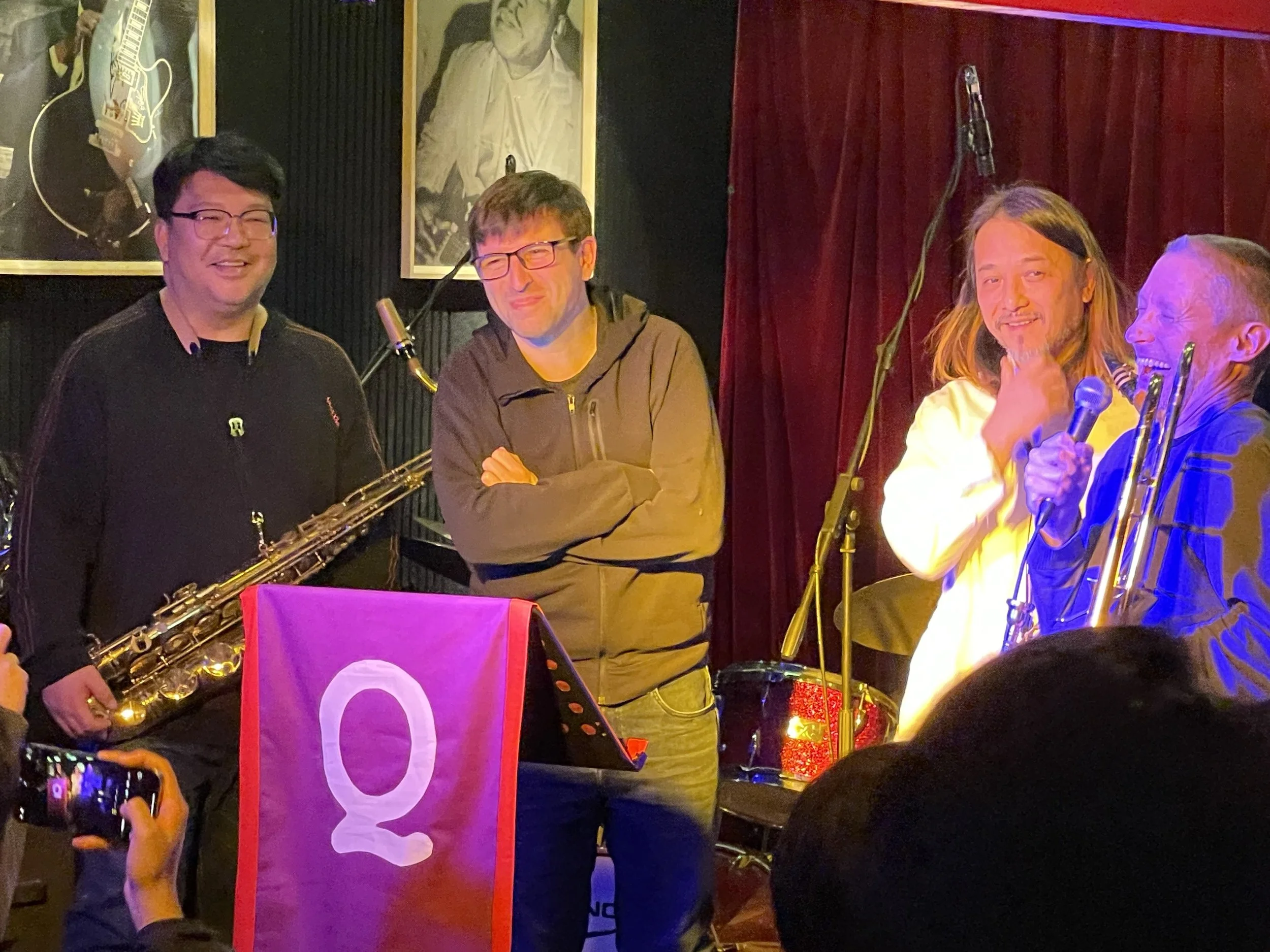
Matt Roberts (right) and Liu Xiaoguang (left) with guests at Jianghu
Who makes up the band? Well, there’s Matt on trombone and erstwhile bandleader. On upright bass is the tall and quiet Dazhong. David Moser, another Beijing long-timer from the USA, is on keys. Scott Silverman is on drums. And Liu Xiaoguang plays sax. It’s an amazing combo of jazz veterans who’ve been playing together since the early 2000s—or in some cases the 1990s. Over the decades they’ve made several albums. Their new album is called No Opinion 没意见, and it’s on iTunes if anybody wants to listen. The band gave out CDs of the album to everyone who bought a ticket for the show.
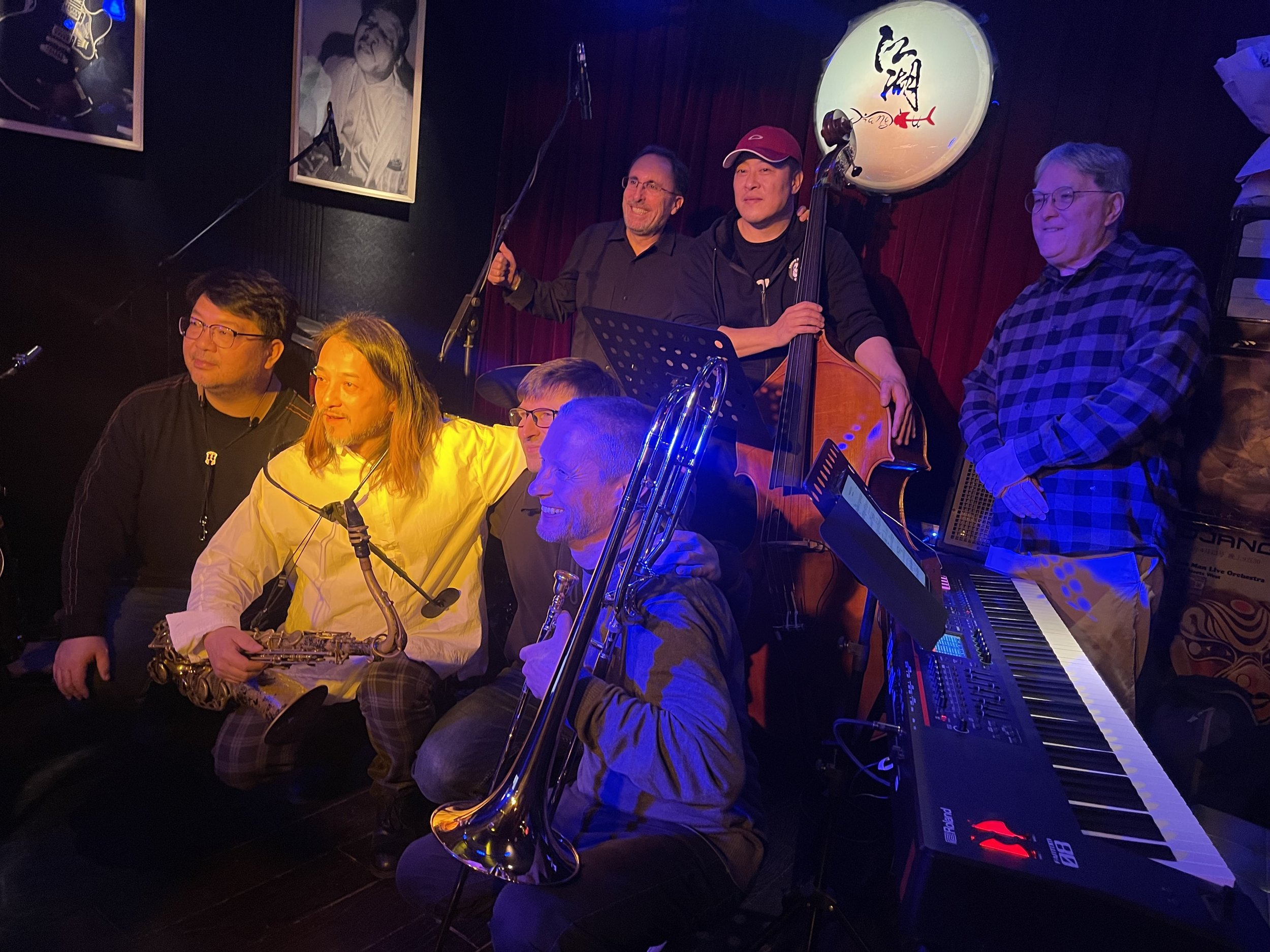
The Ah Q Jazz band posing for a photo at Jianghu Bar
As for style, I’d say that Ah Q plays straight up jazz, with an emphasis on grooves backing long sequences of solos. Except the bass player, who doesn’t solo much, the other musicians all take turns soloing over the groove. At the beginning and ending of a song, Matt and Xiaoguang usually pair up on bone and sax to provide fine harmonic renditions of the main melody or groove. It’s a band that has honed its sound and style over nearly 25 years of playing together. More on the band later in this writeup.
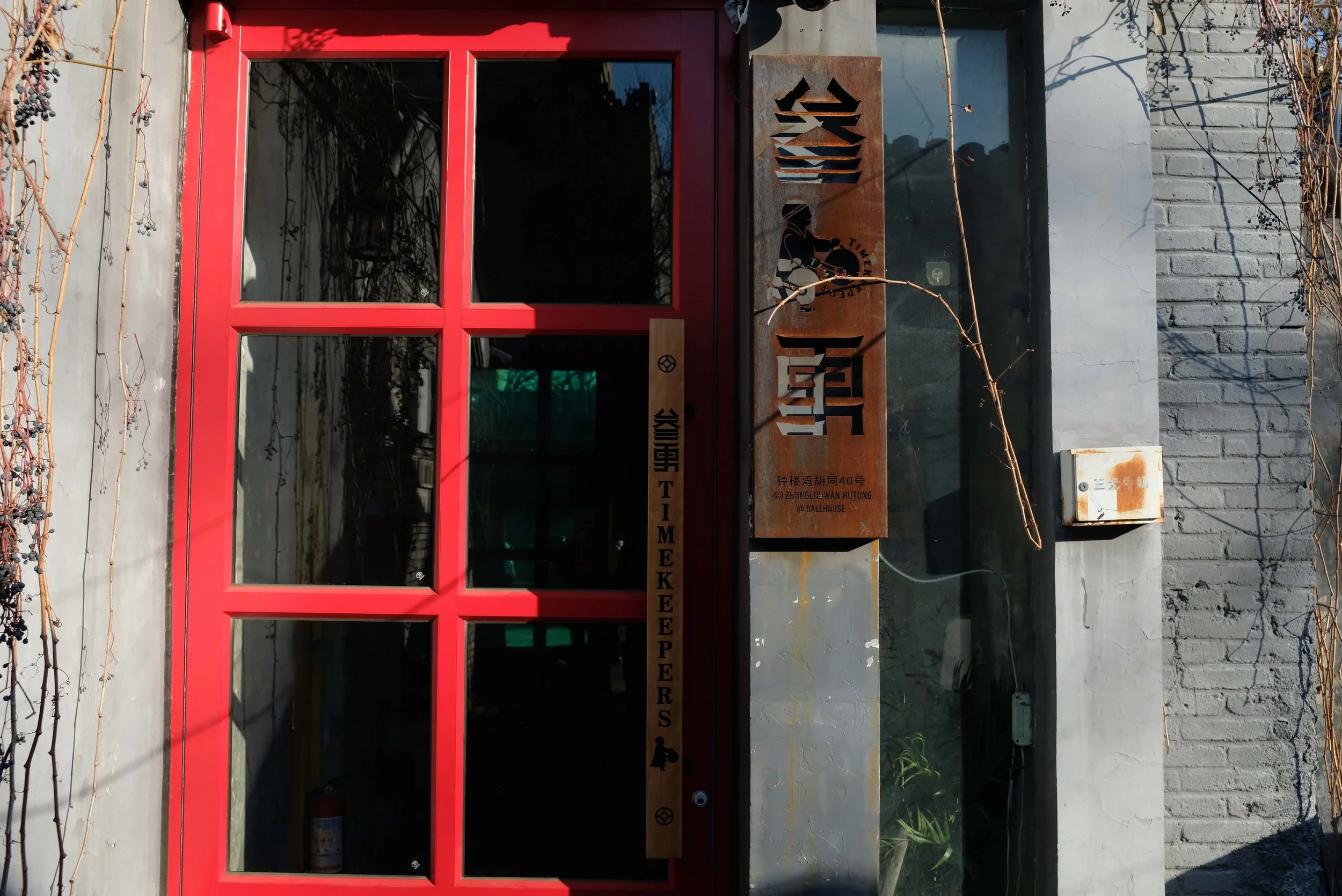
The door to Timekeepers Ball House near the Bell Tower
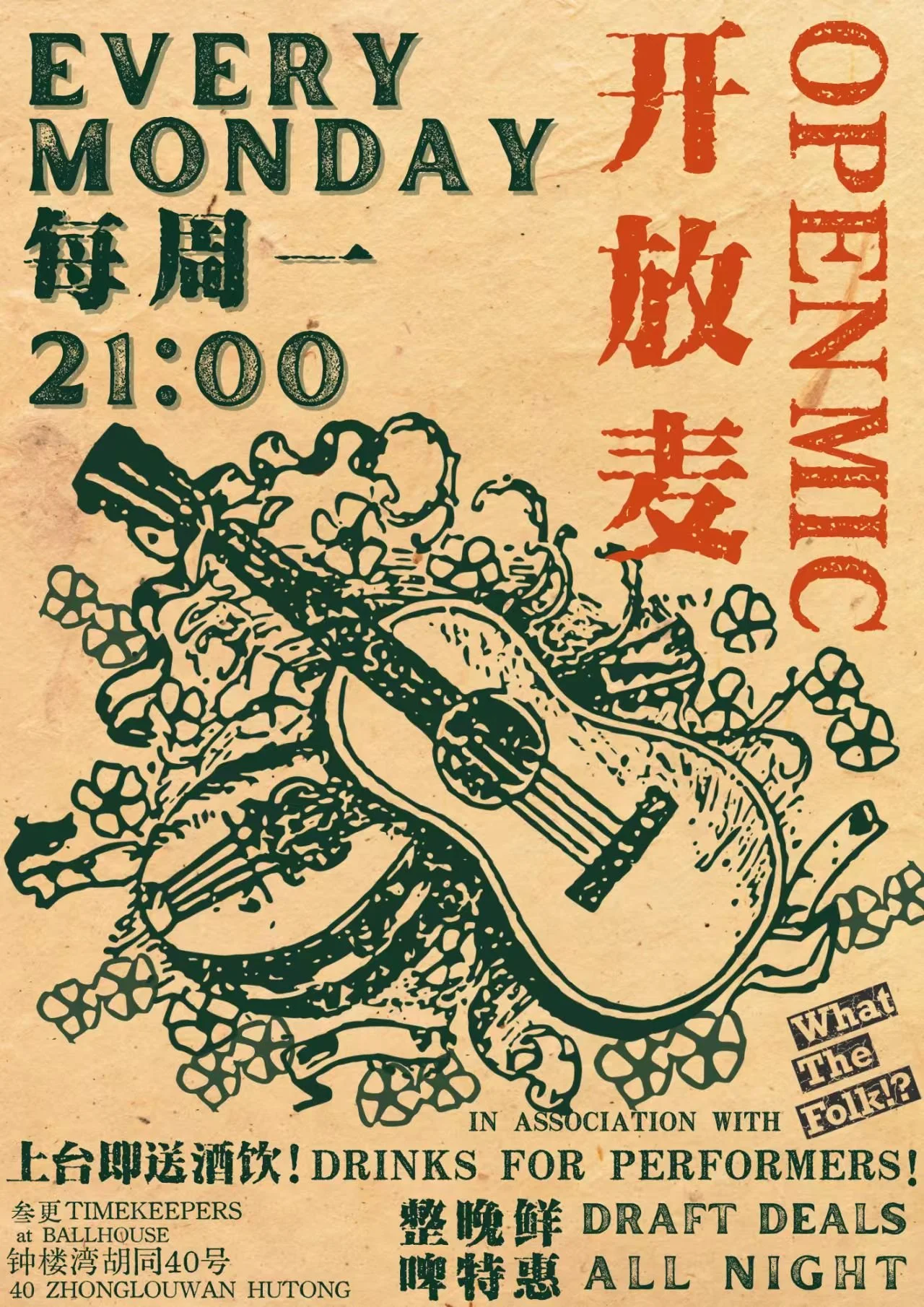
The next day, I took advantage of the sunny if cold weather and took a long walk around the neighborhood. On my way up to Beijing, I’d posted a photo of me on the high-speed train as I like to do, and a Facebook friend named Terry Crossman replied and suggested I visit the Timekeepers Ball House bar located on the east side of the Bell Tower, where they have a weekly open mic event on Monday nights. So, I went looking for it and found it, planning to return later that night. Chinese tourists were busy taking photos in front of the Bell Tower, which looks magnificent in the afternoon sun.
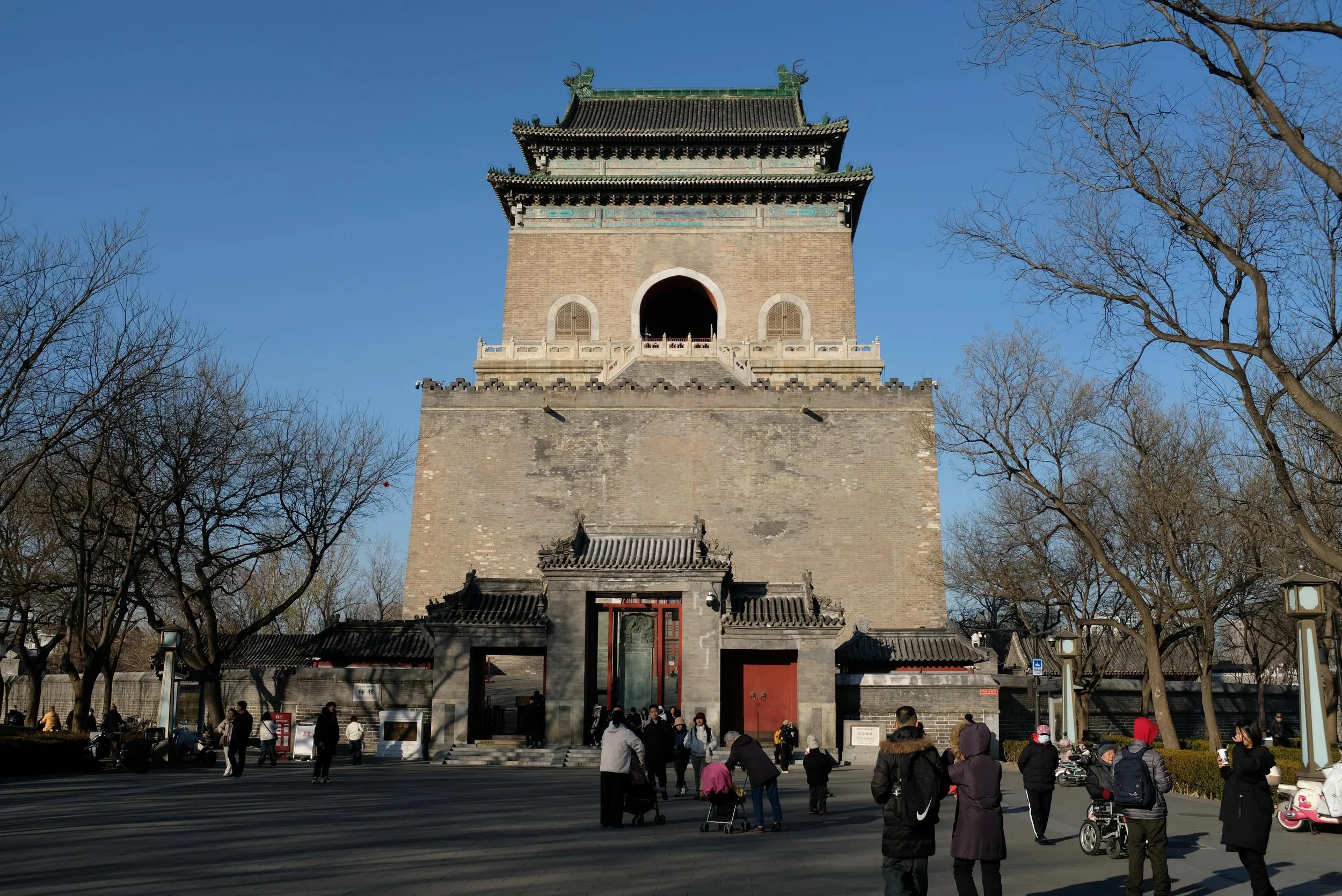
Beijing Bell Tower 北京钟楼
Then I strolled around the Drum Tower and took the alley pathway over to Houhai/Shichahai lake and walked over to Wanning Bridge, the endpoint of my Grand Canal journey 2.5 years ago. I made my way back through the alleys to Nanluoguxiang and up that highly commercialized and touristy lane and back to my hotel. It was a nice afternoon jaunt, and it brought back many fine memories of the filming of our Grand Canal doc series in 2023 as well as plenty of other memories of the neighborhood stretching back to my second stint in Beijing in 2007.
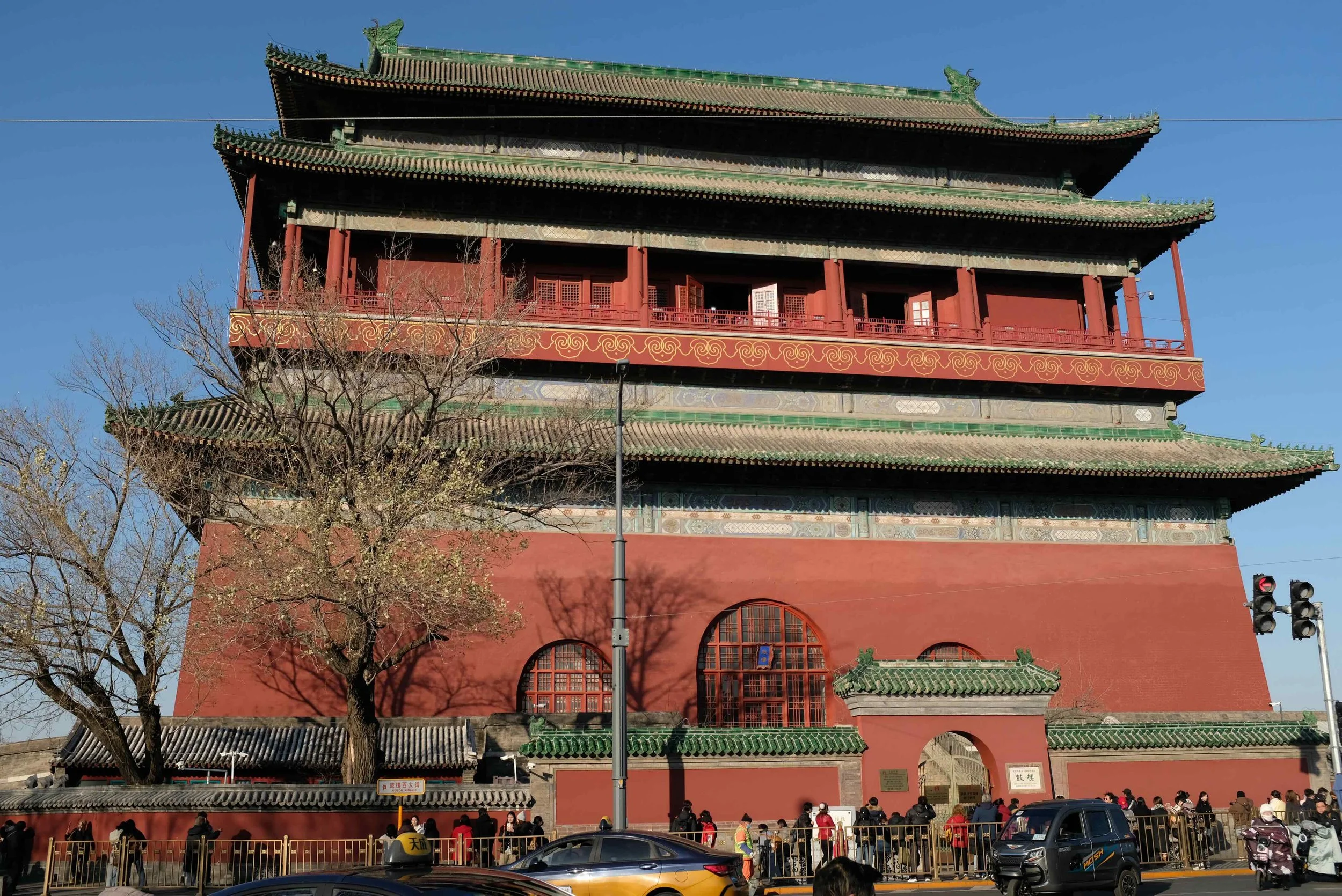
Beijing Drum Tower 北京鼓楼
After resting in the hotel for a while, I headed out again around 9 pm and rode a share bike over to the Bell Tower and entered the Timekeepers Ball House for the first time. Terry was there to greet me and introduce me to the scene there. It was a cozy place, more like a house than a bar, with a fireplace and a living room area with couches where the stage was set up. There were drums, amps, mics, and a mixing console manned by a Chinese guy named Fred.
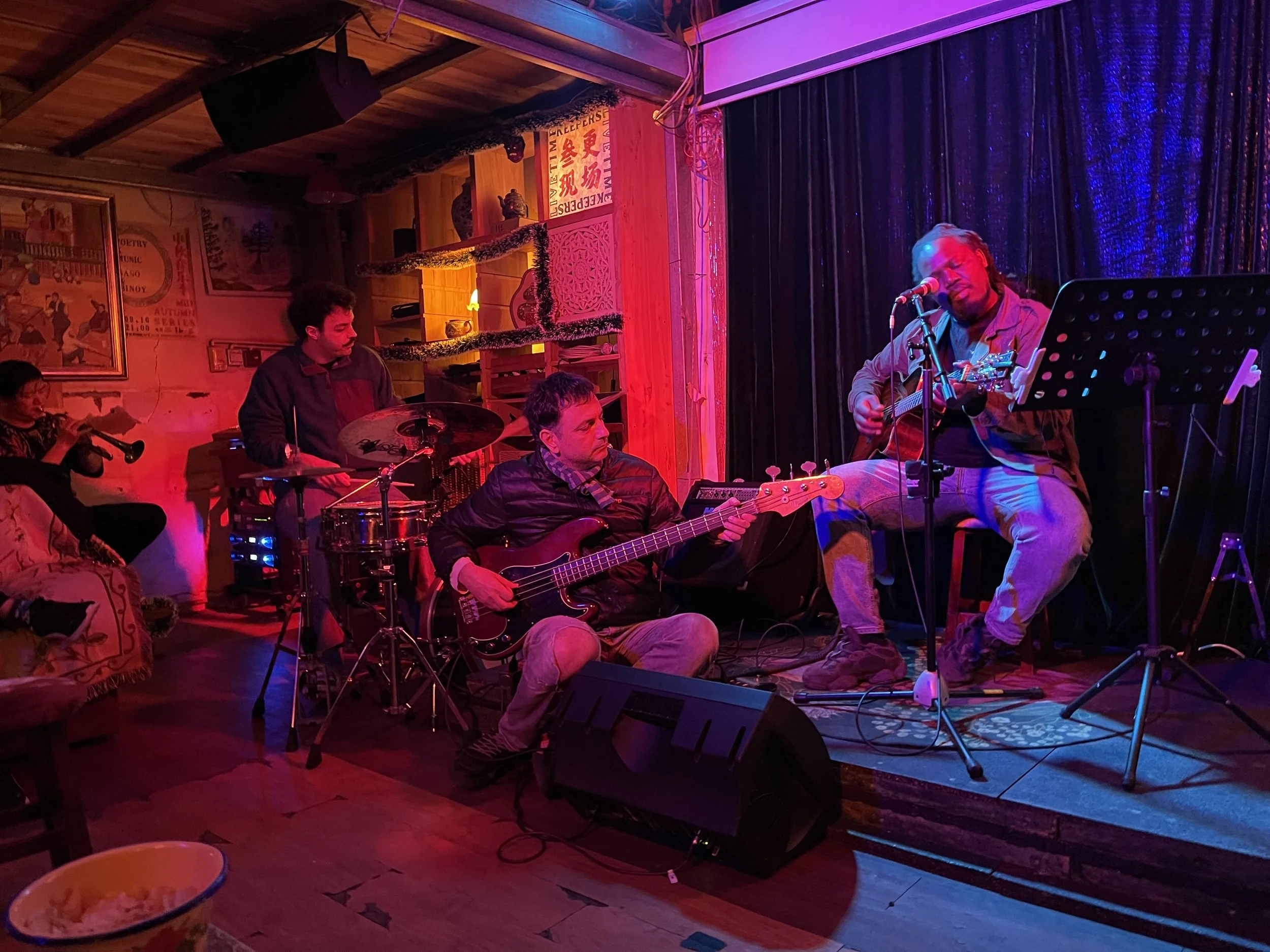
Saso with other musicians at Timekeeper’s Open Mic
A musician from Uganda named Saso ran the open mic session. He started out with some cool reggae tunes accompanied by guitar. After that the open mic began and there was a signup sheet on a clipboard for people to sign up for a round of up to three songs. As someone who has organized open mics in Shanghai and at Duke Kunshan University, I appreciated the efficient way they ran this event. There was a big group of Argentinians there that night, and there were several fine singers and musicians among them. They took the stage for a while, singing Spanish songs echoed by much of the audience.
Eventually it was my turn. I brought my own guitar, even though one was available on the stage, and plugged in. I started with Bob Dylan’s “Things Have Changed”, which has become a go-to song for me in open mic sessions. Then I sang R.E.M.’s “Losing My Religion” and was pleased to find the Argentinians singing along. I rounded out my set with Black Leopard 黑豹’s classic song “Don’t Break My Heart”, a staple in the annals of Chinese yaogun or rock music.
After I wrapped up my set, more musicians and singers came on stage, including a Chinese American lady who played a version of Cui Jian’s Lady of the Boudoir 花房姑娘, another in my list of go-to Chinese songs. She followed that with a Tracy Chapman song and later we talked about Chapman’s rise in the Boston street busking scene. I accompanied her on keys, and ended up accompanying a few other musicians, including a Chinese bartender with long blond hair who sang Bob Dylan and Leonard Cohen songs. The open mic ended around midnight with a jam session with Santy doing some more classic reggae tunes. It was a fine night of musical camaraderie with a multinational set of musicians playing together, and a great way to reconnect with Beijing, my second city in China. Or third perhaps, if you count Kunshan.
On Tuesday, I made my pilgrimage back to one of the most sacred spots in Beijing. No, not the Temple of Heaven, nor the Forbidden City, nor the Summer Palace (been to those places so many times with so many groups of students and family visitors to China I’ve lost count). Not to the Great Wall, which I used to spend days and nights exploring with David Spindler (my other Dartmouth college buddy). Nor the Ming Tombs, which I’ve explored, filmed, and documented in the past with my old buddy Ed Lanfranco. Not to the Lama Temple. But to a place known by three mysterious numbers: 7 9 8.
798 Arts District or Art Zone was built out of an old East German-constructed factory zone on the northeastern edge of the city. Back in 2007, when it still housed many artist workshops, this was one of my primary hangouts, and a great place to commune with artists, musicians and other creative types while taking in samples of the wild and wacky world of contemporary arts in China. Today, it still has some fine galleries such as Continua, which remains among my favorites (though I was sad to find out that Long March is closing). But I’d say its heyday is long gone, and it’s gone the way of many cultural centers in China, now being heavily commercialized with wave after wave of Chinese and international tourists.
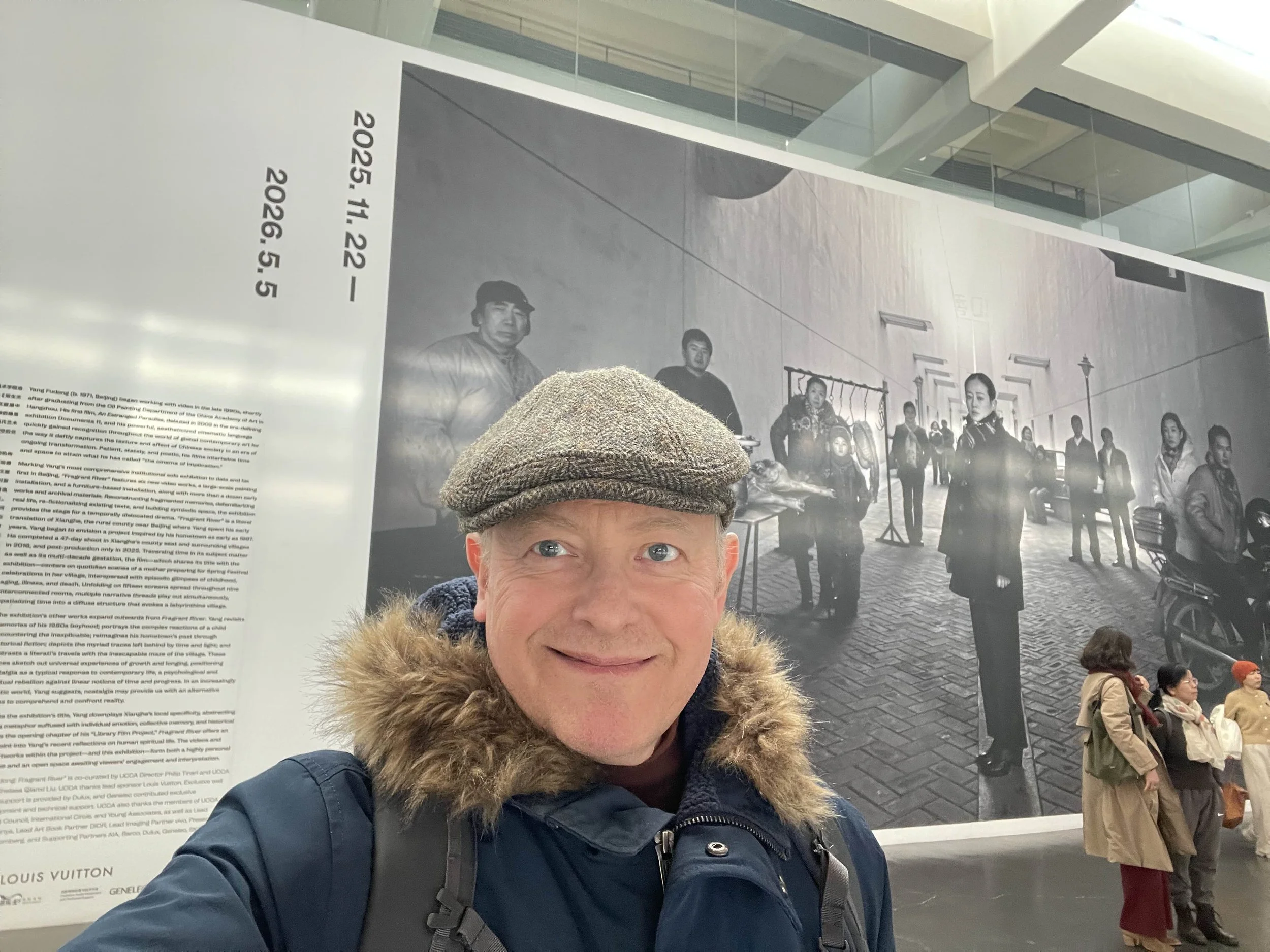
Me (Andrew, the author of this website) at the Ullens Center entering the exhibition of Yang Fudong
I’d been there for the opening of the Ullens Center in fall 2007. And on Tuesday I returned to UCCA, which I always make a point to visit during trips to the national capital. On exhibition was a retrospective and an ambitious project by the artist Yang Fudong 杨福东, reconstructing his own childhood in nearby Xianghe 香河. This was a combo of videos and artworks in the grand halls of the museum, including a set of large size panels juxtaposing old Song style ink paintings (he’d graduated from the China Academy of Arts in Hangzhou with a degree in painting) with videos of weeping willows. After exploring this exhibition while chatting with an old friend in the USA on the phone, I met up with UCCA director Phil Tinari for a quick catchup. Phil told me how the exhibition finally came together after some unexpected yet completely understandable delays.
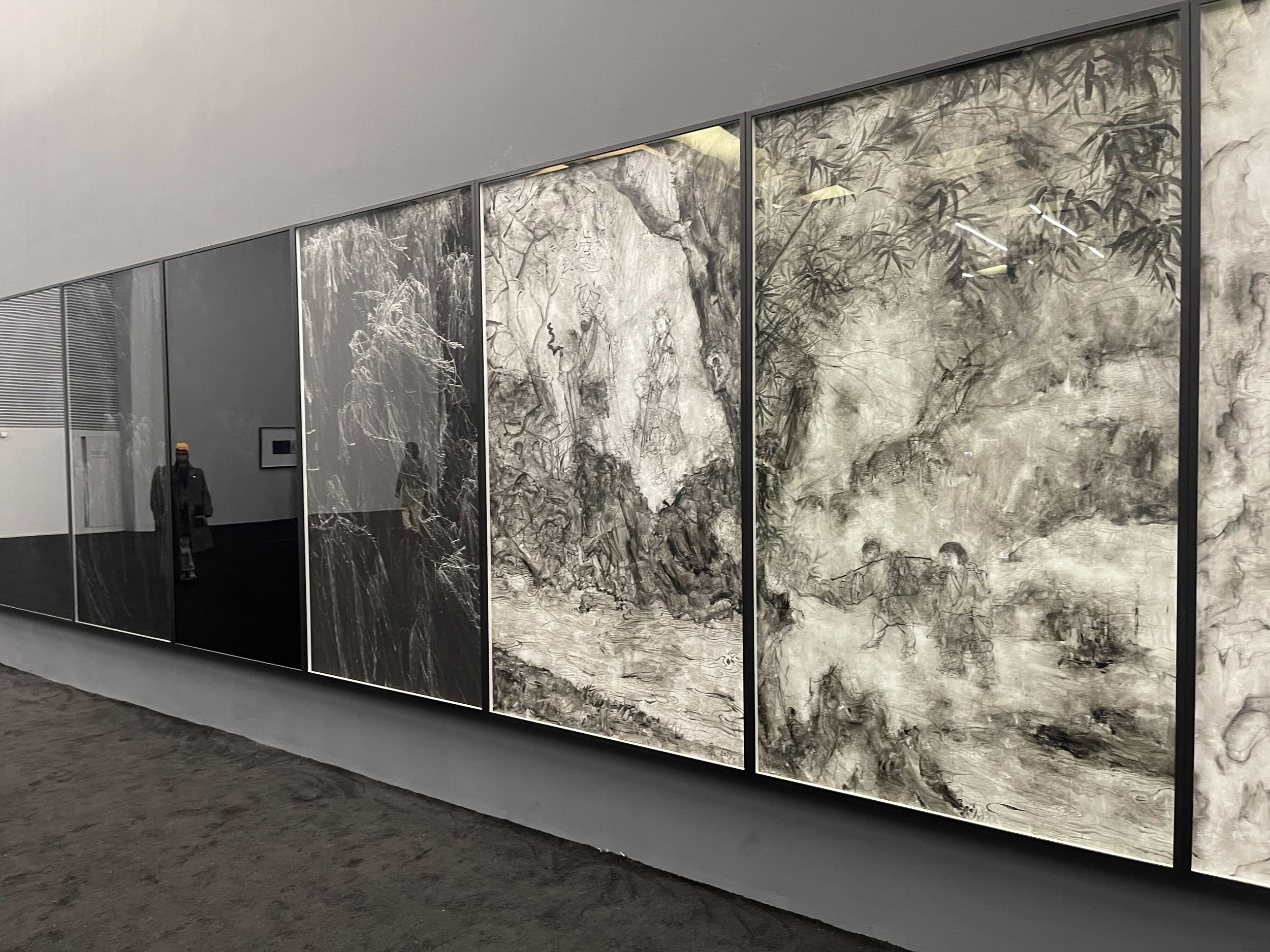
Yang Fudong exhibition panels at Ullens Center
Bidding adieu to Phil, who was busy with numerous other projects in the expanding UCCA empire (they have branches in many other cities and provinces now), I hastened back to the city center. I met Matt Roberts for dinner at a quaint and cozy Yunnan restaurant in the alley across the road from where Jianghu is located. Joining us was Scott Sylvester, the band’s drummer. We had a nice meal of Yunnanese cuisine, while talking about jazz in Beijing. Many of the insights I gained from our conversation will go into the revised version of the encyclopedia article I’m working on with Andreas.
One of Matt’s contentions is that jazz has always been a collaborative effort between Chinese and foreign musicians including those of Chinese heritage who were born and raised overseas. This is a somewhat different perspective to mine, which holds that foreigners kindled the jazz flame both in the 1920s and the 1990s and held court in the clubs and bars of Shanghai and Beijing for a couple decades. Chinese musicians slowly yet inevitably grew into prominent roles in the scene, eventually eclipsing the foreigners. I think both perspectives have their merits and the Beijing scene might be somewhat different to that of Shanghai. The Beijing scene strikes me and others as more communal and less commercial than the Shanghai scene. On the other hand, I’ve also heard that the Shanghai musicians are more collaborative and supportive than those in Beijing. Regardless, there’s no question that close collaboration between and among Chinese and foreign musicians over the past few decades has been crucial to the development of jazz in China as is the case for rock music and other musical styles and scenes.
After dinner, we walked for about five minutes down the alley and across the road to Jianghu Bar, where a jazz jam session was taking place that evening. Scott is part of the house band that supports the jam session. Matt was there as a guest. The bandleader was a jazz guitar player named Chris Chen, who obviously had spent considerable time abroad and was quite fluent in English. I spoke to Chris that evening and asked him how many dedicated jazz musicians he estimated were active in China today. According to his estimate, there are around 40-50 active jazz musicians in Beijing, and maybe 80-100 in Shanghai. Perhaps another 40 in other cities around China. Even if the real numbers are greater, this is still a small number in cities of 20 plus million and a country of 1.4 billion people. Yet their influence is powerful, and as Scott later pointed out to me, even if many people only attend a jazz performance once in their lives, there are still plenty of Chinese visitors to jazz clubs. I’ll get back to this point later in this writeup.
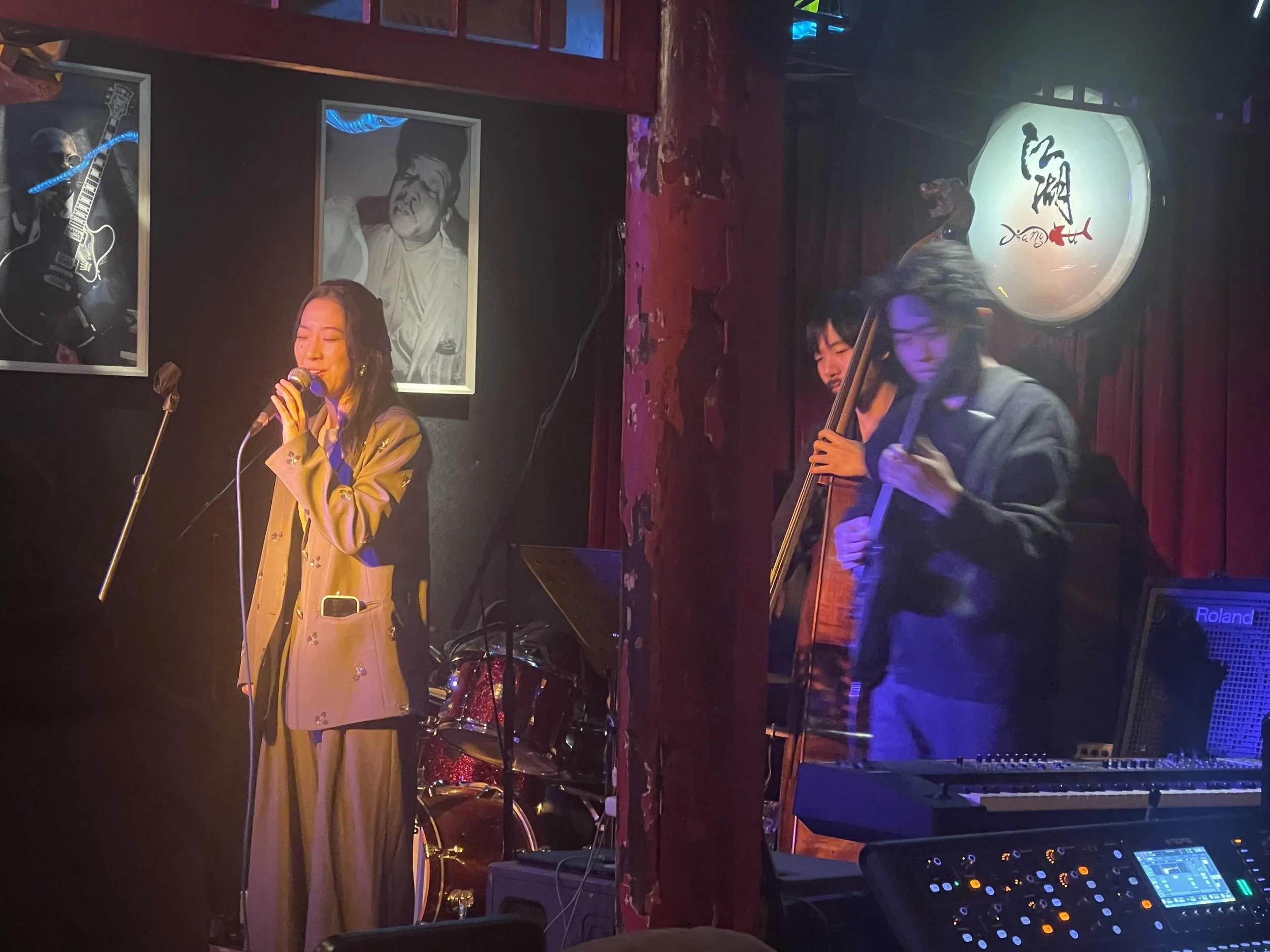
Tuesday jazz jam at Jianghu Bar
That night, Chris and the house band performed along with an elegant and talented female Chinese singer named X, who sang some jazz standards and did some excellent scatting. Later, other musicians took the stage including Matt on trombone. There were a few other female Chinese singers, who also sang jazz standards, though not at the level of X. Still, this was a fine place for jazz musicians and singers to develop and hone their skills, and the audience was supportive and appreciative. There was quite a crowd in the bar for a Tuesday night, suggesting that the jazz scene in Beijing has a small if loyal support base.
Later that night, after returning to the ATour hotel to get some rest, I was rudely awoken by a couple arriving next door. I could hear them very clearly through the walls. The man was obviously drunk and when he wasn’t ranting he kept vomiting in the sink. This lasted until 2 am. Then around 8 am, I heard vomiting again and loud voices in the next room. I decided it was time to leave the ATour hotel and find another place to stay.
Since some of my activities were centered around and beyond the Sanlitun district, I booked a room at the old Zhaolong Hotel, which has recently been renovated and is now run by the Hyatt. I remember the Zhaolong from my first stint in 1996, when some friends had stayed there, and over the years, I’d stayed there off and on. I was pleased to find that it’s now better than ever. The rooms and the lobby have been renovated and restored, and though the lobby isn’t much to behold, my room was quite spacious and cozy, without any of the smoke residue that I dealt with in the ATour hotel.
On Wednesday evening, another old friend joined me for dinner at a Xinjiang restaurant across the Third Ring Road from the Zhaolong (Bei) Hotel. It was a fine and sumptuous meal. Perhaps a bit too sumptuous. After that we strolled a few blocks westward and northward until we reached a street lined with sunken bars on the northwestern part of Sanlitun.
I was searching for a bar called Smoke, which Matt told me has a regular jam session on Wednesday nights. After poking our heads around this street for a while, we finally found it. It was a cozy basement-level bar decorated with posters of jazz legends. I think we were the only guests that night who weren’t dedicated jazz players (I do dabble in jazz piano, but my chops aren’t up to speed). A few young Chinese and foreign jazz cats filled the space including two talented Chinese jazz guitarists (though judging by his voice, one was American), an African saxophone player, a Chinese bassist and drummer, and a trombone player. No pianist that night. I was tempted to join in the jam but like I said, I’m out of practice and probably wouldn’t have been able to keep up with them, even though they were playing familiar jazz standards and trading solos and fours. In any case, the experience has inspired me to set up a jazz jam session at DKU this spring with the aim of training students to be able to join these open mic jams. Seeing as we already have a working jazz ensemble on campus, it shouldn’t be difficult. Later I was told that these young cats are students at BJCMA or 北京现代音乐研修学院。
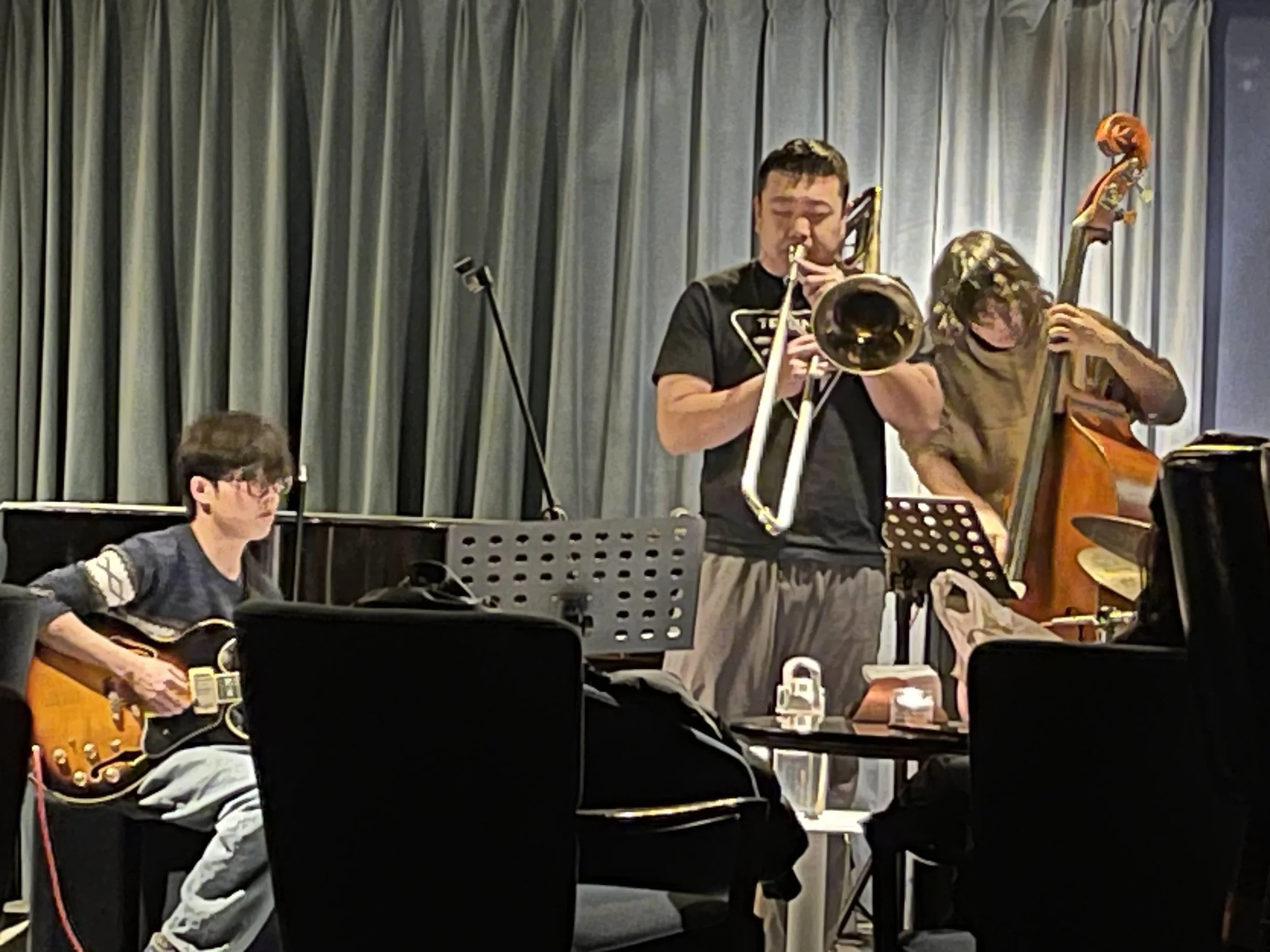
Jazz jam at Smoke Bar on Wednesday
On Thursday and Friday, I wandered around the Sanlitun district, one of my favorite old haunts in the city. Back in my first stint in 1996, it was a loosely connected cluster of bars, hotels, and cafes catering to foreigners. There was Jazz Ya, a Japanese run jazz café that offered CDs of jazz, not live music. There was the Tree and later the Hidden Tree (or was it the other way around), a bar, craft beer and pizza joint that I’d spent many a night in during my second stint in 2007. There was Poachers. There were many others that came and went over the years, and many memories, some of which can be found in earlier blogs on this website.
In recent times, Sanlitun had been taken over by ambitious developers and turned into a fairyland for the nouveau riche Chinese. On both the south side and north side of Gongti Bei Lu, plazas and shopping malls arose, glistening and glittering with glass buildings and fancy name brands. The Apple store based its headquarters in Beijing on the north side. There are still plenty of cafes, but they are now upscale and yuppified, not the lowdown bohemian dives that gave this area so much of its character in previous decades. Also, the Tuanjiehu subway station now connects the area to the rest of Beijing and Sanlitun has become a major Chinese tourist zone. But beyond that zone, the stately old Beijing streets lined with diplomatic apartment compounds, international schools, and embassies remains relatively unchanged. On Friday it snowed all day, leaving a bright patina of snowfall on the ground and on the graceful trees lining the streets.

Sanlitun street with snow
Thursday evening was a very special evening. With my guitar and laptop, I took a cab across the city and over to Peking University or Beida 北大。 I was invited by Dr. Brent Haas, dean of the Yenching Academy at Peking University, and my former student advisee at DKU, Ace Asim, to screen my jazz documentary A Century of Jazz in Shanghai. Recently I screened this 60-minute version of the film twice in Shanghai and I’m still working on the final touches. The audience for this screening consisted of students from Yenching Academy. Afterwards they asked some good questions about Beijing and Shanghai’s jazz scenes, and Brent encouraged them to visit the city’s jazz clubs. After the screening event, Ace and I led a music night jam session for Yenching Academy students in the space next to the theater. Ace has been building up a weekly music night every Thursday. We were joined by a young woman on violin and a young man on trombone and a few other students came to sing songs or just listen. To my delight, some of the students were dancing and really enjoying the jam session.
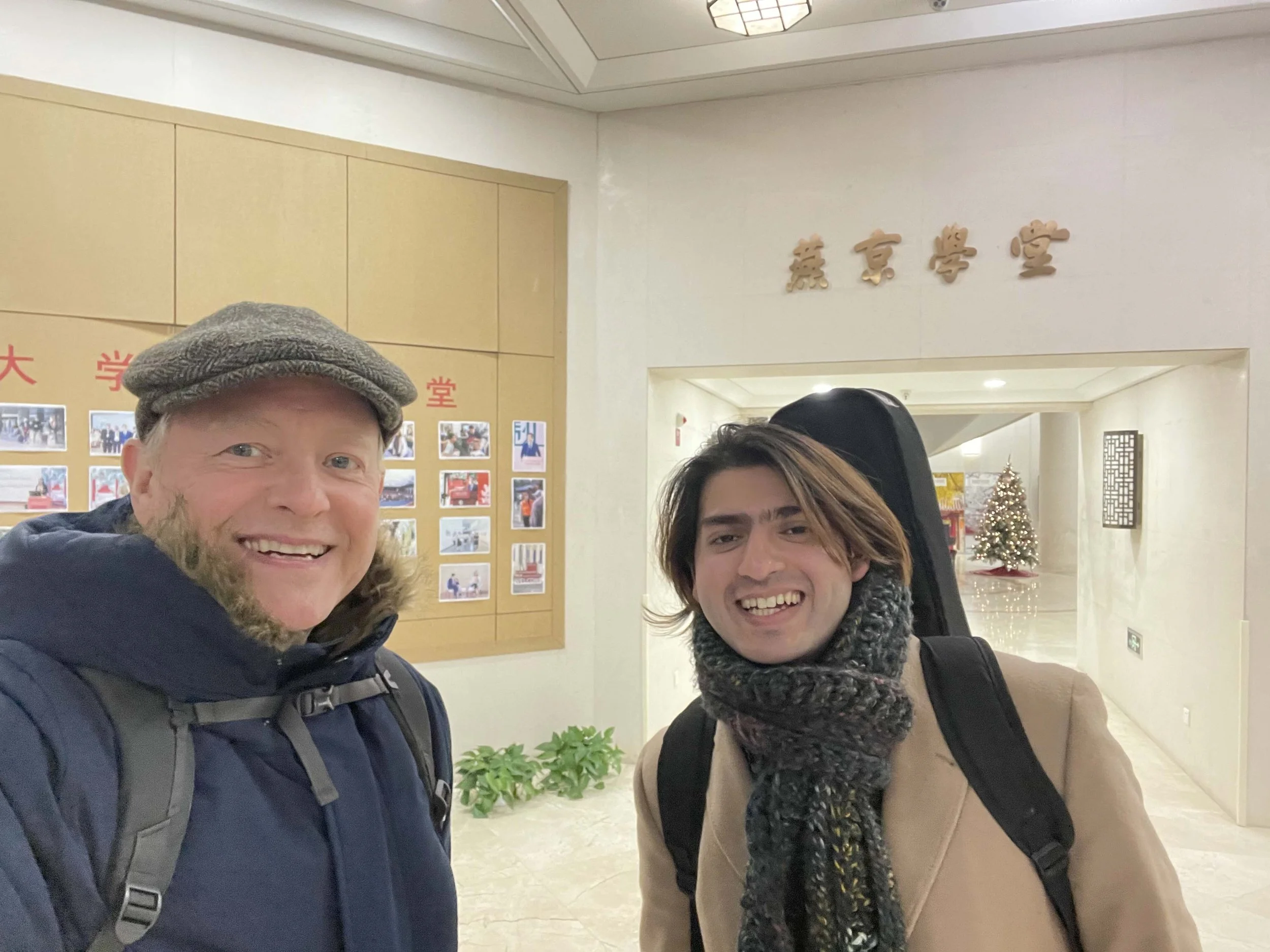
Andrew and Ace at Yenching Academy on Peking University campus 北京大学燕京学堂
It snowed all day and all night on Friday, accumulating an inch or two of snow on the ground. On Friday evening, my last night in Beijing, I took a cab out to an Italian restaurant called Ponte in the northeastern quarters of the city near the Fourth Ring Road. With the snowy roads, it was slow going. It took nearly an hour to arrive. Matt and his band have established residency at this restaurant and play there every Friday night to the dining crowd. It’s an intimate space and the band dominates the space, though people obviously come for the fine cuisine and the wine and not just for the music. I used my iPhone to record the band’s three sets. I’ve always made an effort to document this band, which has played an important role in the city’s jazz scene over nearly three decades now.
In addition to Matt on trombone, Dazhong on bass, Scott on drums, David on keys, and Xiaoguang on sax, the Friday night gig at Ponte also features American guitarist Butch Ford, who hails from Detroit. Butch adds a bluesy R&B flavor to the band’s sound and really rounds out the band with his guitar work. One of the highlights of the performance was a funky rhythmic tune the band played that got the whole audience swaying and bobbing at their tables and in their seats.
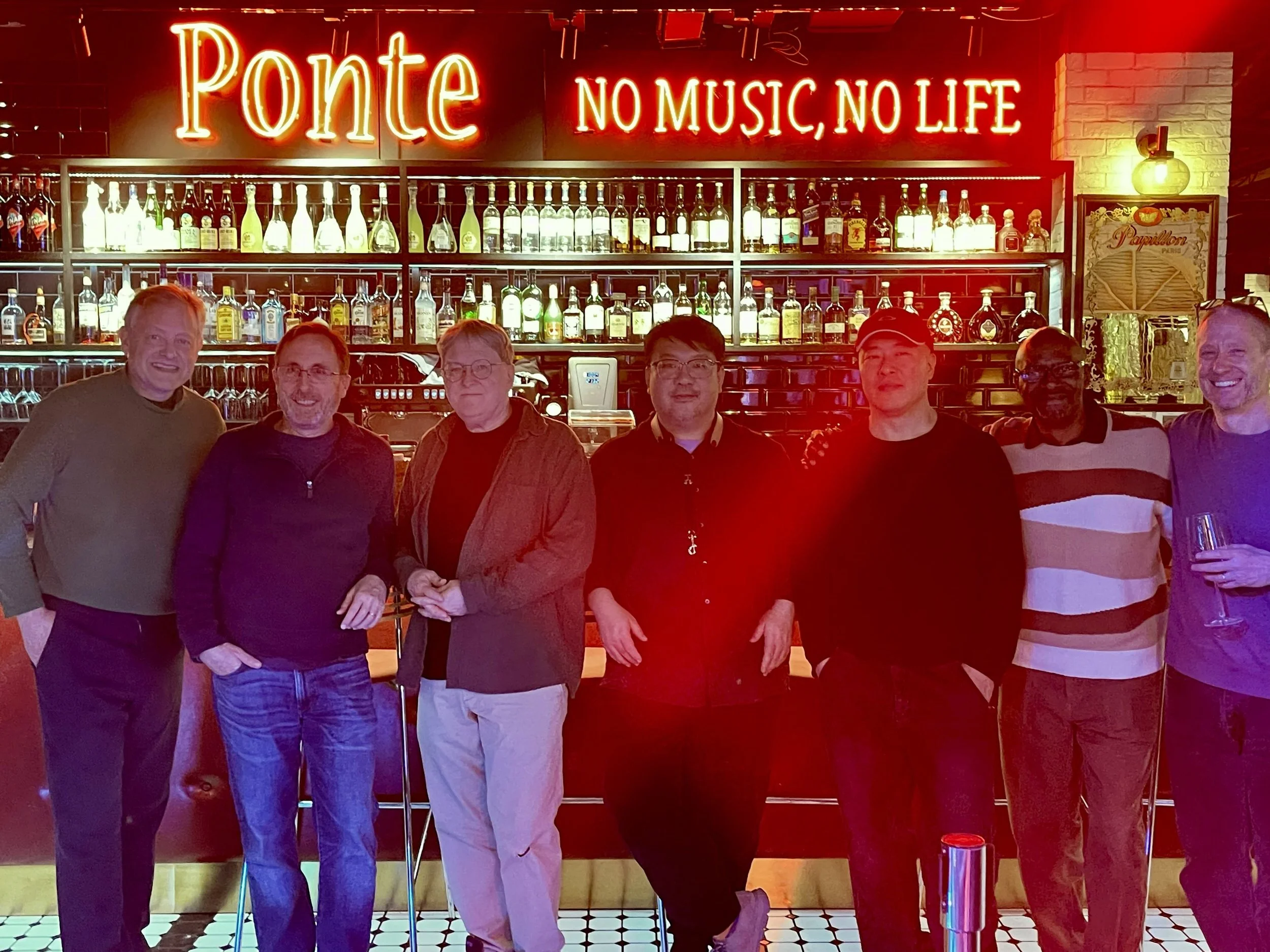
Andrew and the Ah Q band at Ponte
After their performance, the band members stuck around for some conversation, some birthday cake (it was David’s birthday and a couple other guests also celebrated their birthdays that night) and a glass of wine. We talked more about the jazz scene in Beijing and made some comparisons with Shanghai’s scene. Matt and Scott were there for the early phase of the rebirth of the Shanghai scene in the 1990s and have been Beijing based ever since.
David told me an interesting and significant story about Wynton Marsalis’s visit to China in 2000, which David supported as an interpreter. He said that Wynton led jazz workshops in Beijing, Shanghai, and Guangzhou. The Beijing jazz musicians were passingly okay, the Shanghai musicians totally inadequate and unprepared, and the Guangzhou musicians were well prepared and impressive. Same with the questions that reporters in these cities asked. What a contrast to today, where Shanghai’s jazz musicians are the most accomplished, followed perhaps by Beijing and then Guangzhou (though I still don’t know enough about the Guangzhou scene to say for sure).
By around 11:30 pm, we were all eager to get home—and in my case back to my hotel to rest for the trip back to Shanghai the next day. Yet when we tried to book cabs on our phones, the whole booking system was completely overloaded because of the snowfall. It seems that a little snow just paralyzes the city streets. Beijing is not adequately prepared to deal with even a dusting. In my hometown of Boston, the plows and salters would have cleared the streets and sidewalks of snow and ice, but in Beijing the whole city seemed in a state of suspension. Fortunately, Matt’s wife was able to book us a van that took us safely to our abodes around 12:30 am.
This morning, even though the snowfall had stopped, I found that the cab booking system was still overloaded. Fortunately, I was able to get from my hotel onto the subway at the Tuanjiehu station, whose entrance is just a few minutes’ walk from the Zhaolong Hotel. With my guitar and two suitcases in tow, I made my way to Beijing South Station through the now impressive Beijing subway system—a system that barely existed in my first two stints of living in Beijing in 1996 and 2007.
Now I’m on a high-speed train heading south back to Shanghai and feeling vindicated now that I’ve reconnected with old friends, with my second (or third) city, with the jazz scene, and with the very bar that witnessed my near demise 2.5 years ago.
While in Beijing, I was able to connect with several old friends, colleagues, and former students. I reconnected with some institutions that have been important features of the city, from the Ullens Center in 798 to Peking University. I came away with a deeper appreciation of Beijing’s jazz scene and observed some key differences between the Beijing scene and the Shanghai scene that I know so well. I also got to jam and play music with other musicians on two different evenings and would have had more opportunities to do so were my jazz chops up to snuff. It has now become a goal for the future to work more actively and regularly on developing my jazz skills and knowledge of the standards so as to be able to play with other folks in the open mic jazz jams. Next time I hit the national capital, I’ll be ready to rock and roll AND jazz the night away.
Beijing, it was GREAT to be back, and hope to see you again soon!