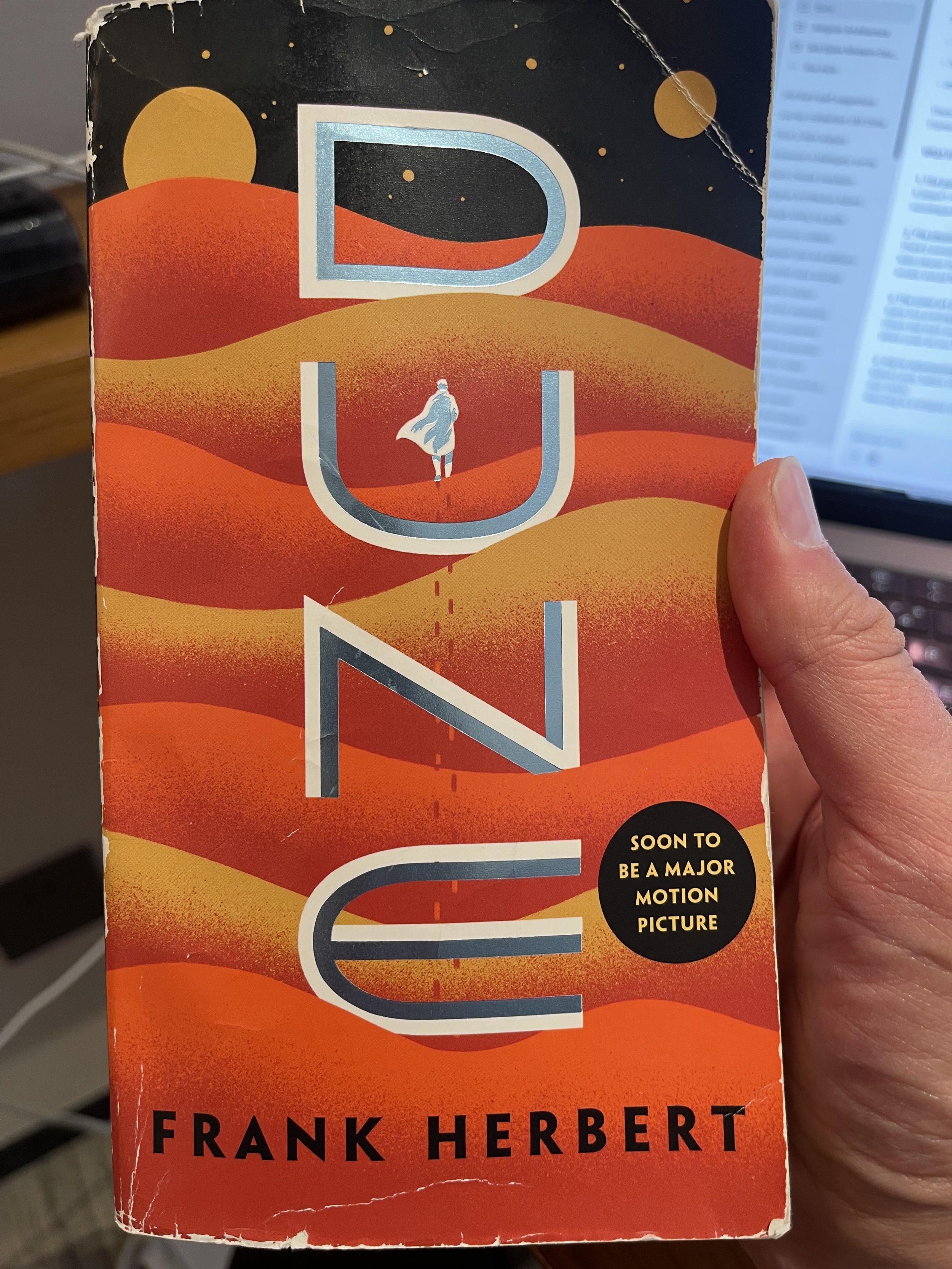
If you're a true fan of Dune, the Frank Herbert fantasy-sci fi novel series about a young man named Paul Atreides who finds his true calling as the leader of the Fremen on the desert planet Arrakis, then you've probably read it more than once. And maybe you’ve even tackled some of the sequels. And each time you did so, you appreciated different things about the Duniverse that Herbert created.
My first reading of Dune was as a 14-year old, about the same age as Paul Atreides, in the year 1984. I remember being absolutely entranced by the novel back then. Sure, there were some technical parts that got a bit dry, but the story moved you along and as a teen I could identify with the main character, at least in some aspects. It was a real coming of age story about a boy forced by circumstances to grow up into manhood far more quickly than he should have.
Of course, this was a boy with special powers, and what boy doesn't dream of having special powers? I trained in karate as a teen and maybe it's one thing that drew me into Asian Studies. And I was an elite swimmer in a sport that offered grueling practices for hours per day during the swim season. As a long-distance swimmer specializing in the 500 yard freestyle event, I came to rely on Zen teachings to help get me through the nerve-wracking swim meets. I was also an elite student at a demanding public school--a mentat in training of sorts, studying AP chemistry, physics, and math, among other subjects. So I could readily identify with Paul and his regimen.
Was my mom a Bene Gesserit? Of sorts. She was a hyper-educated and hyper-intelligent working woman who'd first taught me to read and who raised us singlehandedly for years before my step-dad came into the picture. So in many regards, I felt a strong identification with Paul. As did so many other boys who read this book in their teen years, I suppose.
In 1985, I saw the David Lynch (or Alan Smithee) Dune movie in the theater with my father. I remember coming out of it feeling that they'd captured certain vital aspects of the story, even if they indulged in their own interpretations in many parts, especially with the costume and stage designs. To this day, Patrick Stewart is my mental image of Gurney Halleck.
KWISATZ HADERWHAT?
Years later, when I was just graduating from college and moving on to grad school for a PhD program, I had a dream. In the dream, I was in a big cavern maybe in the desert, and someone was calling me the Kwisatz Haderach. I hadn't heard that name in years, so it was odd how it popped into my brain. I told my dad about the dream, and he said, "Of course you're the Kwisatz Haderach, you're going on to a PhD with a full scholarship!"
But the connection was more than surface level. I was going on to earn a PhD in Asian Studies with a focus on Chinese and Japanese languages. Like Paul, who immersed himself in the world and the language and culture of the Fremen, I was embarking on my own journey of deep learning and experience in East Asian societies, immersing myself in that world and coming out changed.
And there was a sort of Messianic element to it all. As a scholar of Asian Studies, focusing on modern history, I would build an understanding of this vital part of the world, which used to be the place where the British East India Company and other western shipping companies lined their pockets with the profits of the lucrative tea trade, while importing opium into China. Other parts of Asia had the spice trade.
THE SPICE MELANGE: OPIUM TO FACTORIES
Ah, spice! In more recent decades, this part of the world, especially China, has been the world's factory (aka Arrakis), propelling the machinery of the world from bicycles and cars to cameras, computers and semiconductors. It was a part of the world that was exploited by western powers (read: the Harkonnens) and which would eventually rise up under its own Messiahs (read: Mao), but also with a knowledge of its own increasing powers that drew upon a combination of western-inspired technology and ancient Eastern wisdom.
By the 1980s, Japan was already being perceived as a threat to America, though one that subsided by the 1990s as the country entered a long recession, and China was still a poor country with a potentially large manufacturing base. Over the next decades, as China became the world's factory, this country would grow in strength and eventually come to challenge the USA, in perception if not necessarily in reality, for hegemony over the globe.
Where did I fit in? Perhaps my role would be one of peacekeeper, promoting mutual understanding across the globe between and among the people of these titanic powers. And to the extent that I'm still an idealist, I still believe that's a huge part of my mission here in China.
FITTING ON THE STILLSUIT
While Beijing might require a stillsuit for its dry climate, Shanghai certainly does not. My second reading of Dune took place around the time my second daughter was born, in 2009 or 2010 (honestly I can't remember which, though I do remember my daughter being born in 2009 of course!). I recall reading the book in Shanghai and then reading the first three sequels, which I found in tattered paperbacks in a local bookshop in my hometown of Acton Mass. Maybe it was the realization that my own life had changed and I was now responsible for two daughters who were growing up bilingual and bicultural and who represented the union of Chinese and American cultures and societies.
Whatever drew me back to the Duniverse, it was once again a complete immersion in this alternate worldscape, this time going much further and deeper into it than I had as a teen. By this point in my life, I'd spent over a decade living in Asia Pacific, mostly in China but also five years in Australia, which with its vast Outback and Red Center bears some resemblance to the desert planet. I'd achieved my goals of becoming functionally fluent in Chinese and Japanese languages (more the former than the latter) and understanding the contours of their languages, cultures, and histories.
Having married a Chinese woman in Shanghai, living there with her family and taking on roles in Shanghai--based universities and programs as a professor of Chinese history and study abroad director, I was about as integrated as a foreigner could be in Chinese society. I was even training for a while with a master of Tongbei, an ancient Chinese martial art, who could have given Gurney Halleck a run for his money.
While I didn't style myself a Kwisatz Haderach, and there were no direct equivalents to the Shai-hulud in the metropolis of Shanghai, save the subway system and later the high-speed rail lines connecting Chinese cities, there was still something of Paul in me. Or perhaps the planetary ecologist Kynes. With their deep immersion in local culture, language, and folkways, Paul and his erstwhile mentor Kynes had shown me the way.
One man’s monster is another man’s high-speed rail through the desert — terrifying until you learn how to ride it, deadly if you pretend it doesn’t shape the land beneath your feet.
Fast forward to the past three years. We survived the pandemic, even thrived in the sense of using the crisis to seek a return to nature—see all my posts about the nature hikes and observations I was making about birds and trees between 2020-2022.
FROM CERTAINTY TO AMBIGUITY, DESTINY TO RESTRAINT
Then in 2023, I had my own Kwisatz moment--my brush with death and my two-week struggle to survive. Ironically, this happened in Beijing, which I consider the "mother ship" of China, where I had some of my most significant and adventurous experiences.
Now, I was in a hospital in Beijing surviving a heart attack, brought on quite suddenly as they tend to do, like a Worm in the desert. And during those two weeks of struggling just to breathe and to eventually return my bodily functions to a normal state, I had many hallucinations. I saw the network that binds us all together as human beings, with family and close friends being the primary nodes, like jewels strung across a vast and intricate web. And I believe I saw beyond the pale of death, even as I struggled to live.
I didn't reach for my dog-eared copy of Dune then. But I suppose Paul was waiting in the wings for me to return to his story and make more connections with my own life. I do recall seeing the new Dune movie starring Timothee Chalamet as Paul Atreides, not long after it came out in 2021, in a Shanghai cinema with my family. Seeing the film brought back memories of the story of course, but it didn't immediately prompt me to reread the book.
The second Dune movie came out in 2024, and once again we saw it in a theater in Shanghai. Or did we? Maybe we saw it on our home theater? Funny how memory plays tricks with time and space. Then came Dune: The Prophecy, going back in time to the earlier stages of the Harkonnens and the Bene Gesserit. My daughter and I watched the show, and are waiting for the sequel. (We watch a lot of sci fi and fantasy series together).
A few weeks ago, I picked up a paperback copy in our home library of the first and most classic book of Dune, and decided to read it again. I found myself once again completely immersed in the Duniverse, enjoying all the moments that led to the transformation of Paul Atreides from a young innocent boy into Muad'dib the prophet, warrior, and leader of Fremen.
I devoured the book over a two-week period, reading it as I returned to Beijing for the first time since my heart attack in 2023—see my previous post for details. Somehow it had a special significance for me as I made this journey to the place where I had experienced my own Kwisatz awakening.
By this point, Dune was no longer a book about becoming someone extraordinary — it was becoming a book about surviving systems larger than oneself.
But this time I noticed different things about the story. I noticed how complicated the politics was between and among the key players in the Duniverse. I noticed the subtleties of the dialogues, which are lost in the epic sweep of the films. I observed all the minute references to language, culture, technology, and ecology that Frank Herbert supplies us in this amazing and unique act of world-building, perhaps only rivaled by Tolkien.
I felt more deeply the ambiguities behind the various characters, including Paul himself, who is very much a flawed heroic figure. And there was the character of Count Fenring, completely overlooked in the films I believe, who was a flawed counterpart to Paul, and whose sympathetic connections with Paul ensured his survival at the end of the story.
I even felt some hints of compassion for the Harkonnens, who are treated as caricatures of pure evil in the movies, but who come out as somewhat more nuanced, subtle, and complex in the novels. It's not that they aren't cruel and evil beings--that much is clear--but they are so obviously caught up in the net of their own societies, mores, and their own place and status in the Duniverse.
When Feyd kills the female slaves, it isn't out of a pure sadistic malice or cannibalism as in the movies, but grudgingly and sullenly because he is ordered to do so by his uncle, who has caught him in a failed assassination attempt. The scene where Baron Harkonnen confronts his wayward nephew is one of the best scenes in the book in my reckoning.
Despite all the cruelty and misery he inflicted on others, one feels a touch of sympathy for the Baron when he is poked by his granddaughter Alia with the Gom Jabbar in a scene completely missing from the Villeneuve movie. And despite Feyd Rautha's boasting and taunting, one feels a tinge of sadness when Paul finally drives his krysknife up into his opponent's skull. After all these are cousins and rivals, and they would have had so much to talk about and connect over if they hadn't been caught up in the political machinations of their own houses.
Thus, while we can see the obvious differences between Duke Leto Atreides, who saves his men while sacrificing the machines that collect the Spice, and Baron Harkonnen who sends his nephew "Beast" Rabban to rule over Arrakis with a cruel hand, we also feel that these men are all humans caught up in the nets and traps of the broader political and social systems that rule over them. Even the Emperor deserves some sympathy, despite sending out his Sardaukar warriors on a genocidal pogrom to rid the planet of Fremen. And the Sardaukar? Having come out of Salusa Secundus, the prison planet, and survived the ordeal, who can blame them for their behavior?
What Frank Herbert may be telling us is that nobody and no society is purely good or evil, and everyone is the product of the systems and societies that raised them, nurtured them, protected them, challenged them, and bestowed their values upon them. And Paul? He is desperately trying to prevent the galactic Jihad that he knows with his Kwisatz prescience will be the ultimate result of his training the Fremen in the Weirding Way.
I haven't even gotten to the Bene Gesserit. Of course, Jessica is caught up in her own web, having been trained by this secret order of women with its generations-long scheme of genetic manipulation and political intrigue. Her main act of defiance was to bear a male child.
What does this have to do with my own life and my experiences in China and the Asia Pacific? Well, over the decades, I've come to appreciate the nuances of the different social, political and cultural codes that operate in this part of the world, as well as in the USA, a country I haven't lived in for many decades save my seven-month stint there in 2020, but which I will always call home.
Unlike my young teen version or my idealism as a college student or grad student, I've come to realize over the decades that world is a far more complicated arena and that no side of the battles that are waged is purely good or evil, neither is any system. I've come to appreciate the importance of studying, looking, listening, learning, and observing without rushing to judgment.
I just hope that Herbert's deeper messages will resonate more broadly, and that more people will read and reread his magnum opus, for not only is it a ripping tale, but there is great wisdom to be gained by doing so and listening to the vox clamantis in deserto.