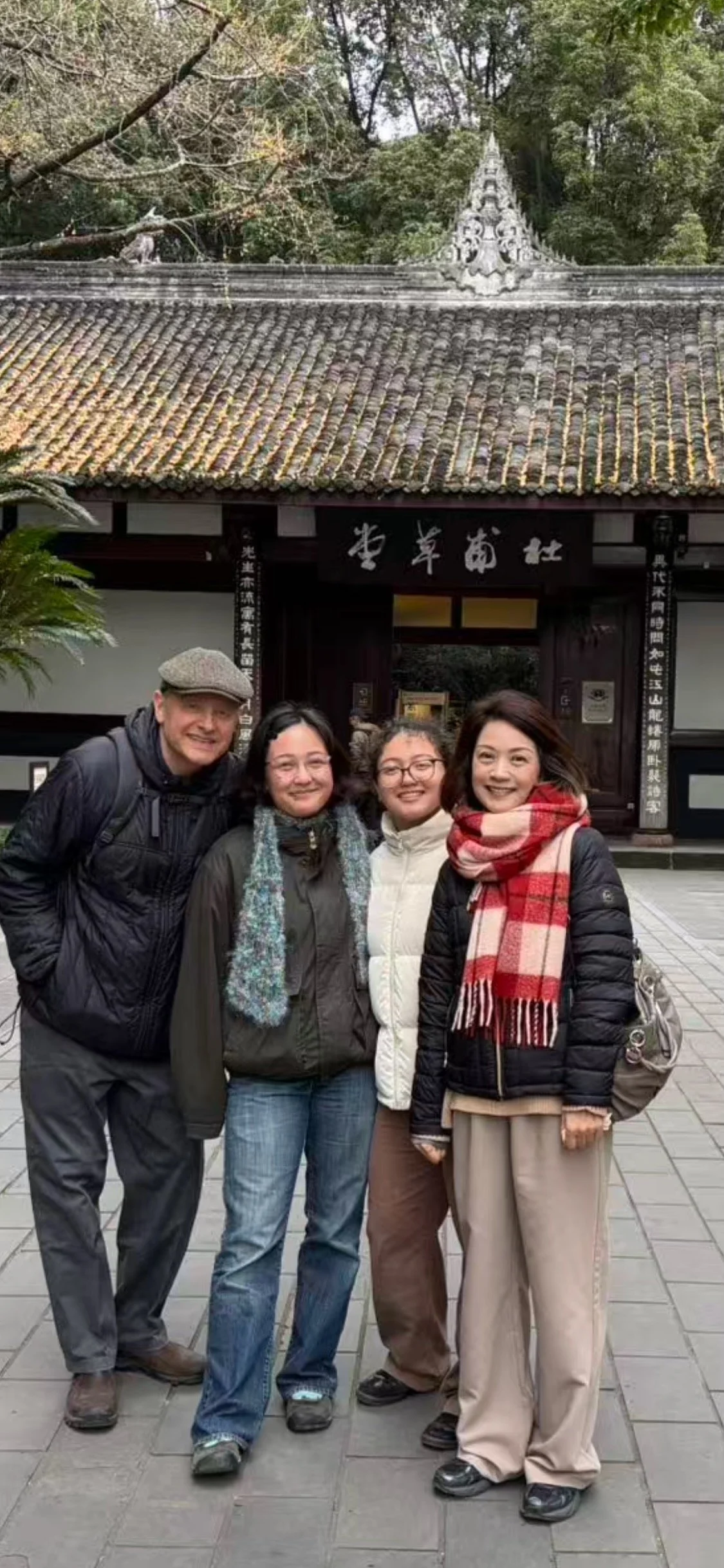
Here is a rundown of our four-day trip to Chengdu over the Christmas holiday, which might be useful for others planning a visit this city:
At the end of the previous year, we traveled to the southern rainforests and ethnic minority mountain communities of Yunnan Province in southwest China. This Christmas, for our family holiday excursion, we chose a different destination: the capital city of Chengdu in Sichuan Province. It turned out to be an excellent choice for a trip with my wife and our two daughters, now in high school and college.
Chengdu offers visitors a wide range of experiences, and we were fortunate to sample some of its best. No first visit would be complete without seeing the giant pandas in the reserves that lie to the west and north of the Chengdu Plain, ringed by mountains. At the same time, the city and its surroundings are rich in historic sites, many of them within easy reach of the city center, where we stayed at the JW Marriott just off Tianfu Square (天府广场).
Day One: Arrival
The flight from Shanghai to Chengdu takes three hours. We arrived in the afternoon and took a cab to our hotel in midtown. On first impression, with its tall nondescript apartment buildings, hotels, and office towers, Chengdu looks like many Chinese cities. Yet as we found out while walking around town it has its own distinctive character. After checking in at our hotel and resting a bit, the girls went out on their own to visit the Taikoo Li, an upscale mall not far from the city center. My wife and I walked around Tianfu Square, passing by the statue of Chairman Mao that stands prominently in front of what is now the Science and Technology Museum, facing southward and overlooking the square like a latter-day emperor.
We passed by the large museum buildings that are clustered around the city center (unfortunately we didn’t have a chance to visit them this trip). We walked by many Muslim (huizu) restaurants, as it seems they are clustered in this part of town. We then headed into the People's Park and strolled around inside the grounds with different gardens and areas to explore.
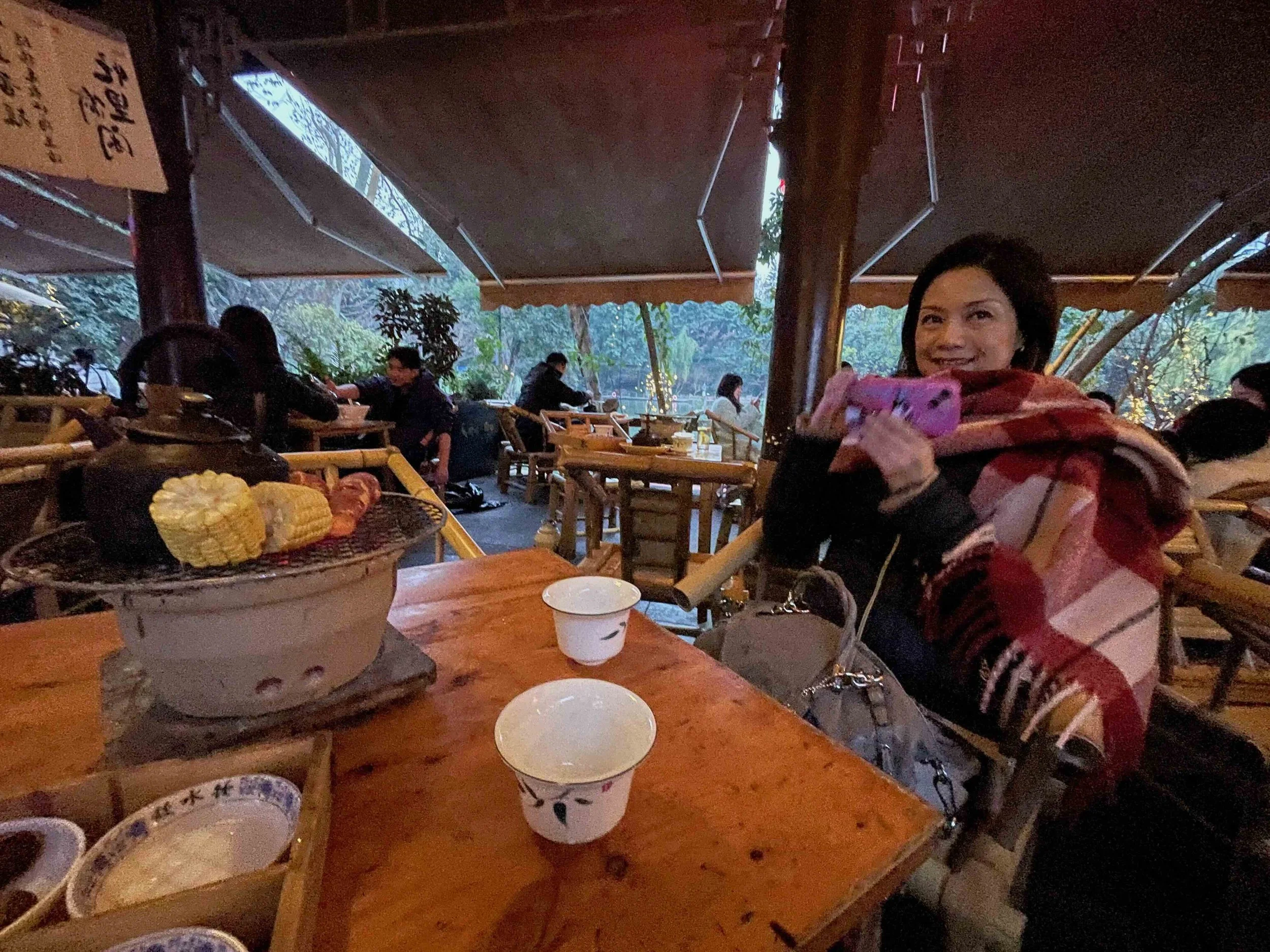
Warming up in a teahouse in People’s Park
Eventually, we settled ourselves in an outdoor tea house that served pu'er tea in crockery heated by an old-style ceramic stove full of glowing hot coals, which also provided some welcome warmth in the cold and clammy winter climate of Chengdu. Our daughters eventually joined us there, and we walked back together toward the hotel and had dinner at a hotpot restaurant in a nearby building. The hotpot meal was tasty, but the place was a bit noisy, and like many restaurants in town it featured a performance of "mask changing" (变脸 bianlian), which is a Sichuan specialty.
Day Two: Pandas and Ancient Hydrology
My wife arranged with the hotel concierge for a driver to drive us one hour northwest of the city to a famous scenic area and historic site on the edge of the mountains called Dujiangyan 都江堰. Before we visited this place, we spent the morning at a nearby panda reserve known as Panda Valley (熊猫谷), walking with other visitors up the gentle hillside alongside flowing streams into the forested mountain reserve. At various stations along the way, we saw giant pandas in habitats constructed for the reserve. There were indoor caged areas where the pandas lived, but in daytime they could lounge about outdoors in semi-natural environments, walled off of course from the visitors. Mostly they were napping but some of them were having breakfast, munching on bamboo leaves. It seems they are well attended and we were impressed with the pandas, whose names and ages are displayed on signs near their habitats. We walked further up the hillside into an area featuring red pandas or lesser pandas, which are much smaller and have reddish fur on their backs, black legs, and long red tails. They were walking along a system of elevated walkways made of narrow logs set up along the hillside and seemed quite comfortable with the crowds of people who watched them and took photos (including us of course).
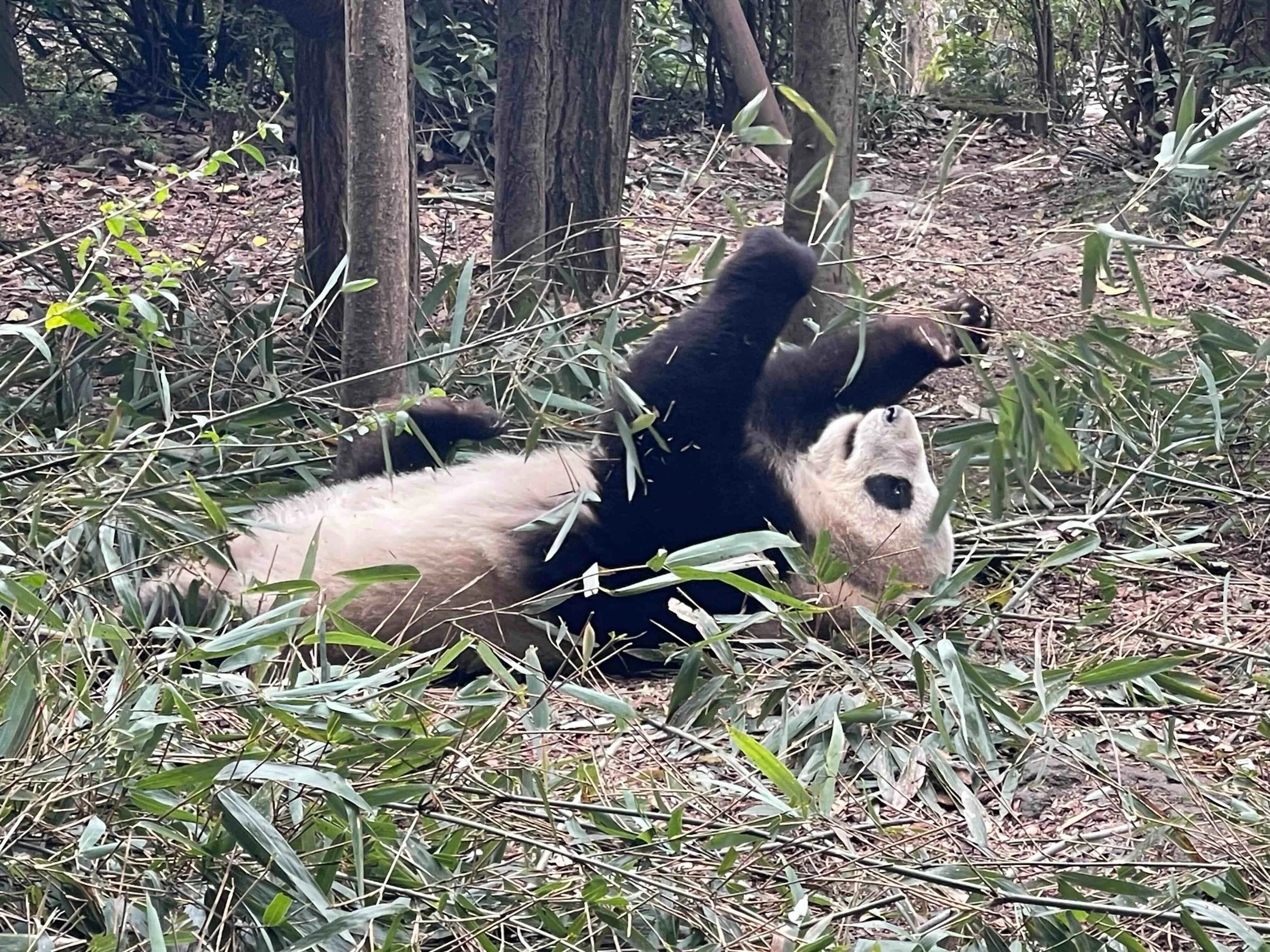
Giant Panda in Panda Valley reserve
We exited the panda reserve around noon, and our driver picked us up and took us to a nearby local restaurant he recommended where we had a nice lunch. Then he drove us over to Dujiangyan. It's a large and scenic tourist area containing an ancient system of waterways and a few temples and shrines. Dating back to around 250 B.C., this irrigation system was designed by an official named Li Bing 李冰 on the orders of King Zhao of the State of Qin. This state eventually became the Qin Dynasty that reunified China after centuries of strife and war.
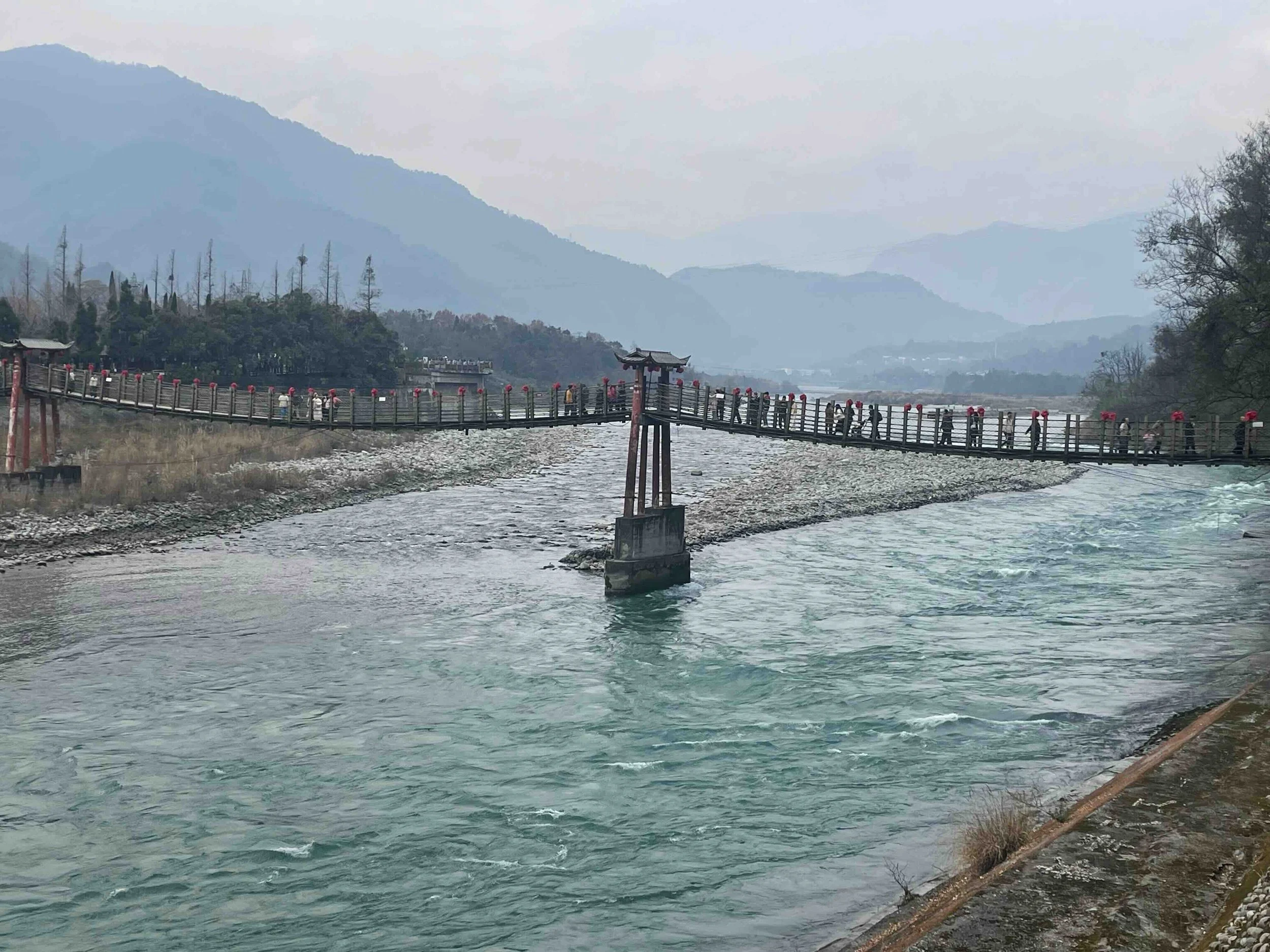
Rope bridge across the water at Dujiangyan
With the aid of an army of workers supplied by the king, Li Bing diverted part of the Min River (岷江), a major tributary of the Yangzi which runs through this part of China. They created a fast-flowing narrow river alongside the main river and used some ingenious methods to keep the water from silting up, eventually creating an irrigation system that mitigated flooding in the plain while creating the stable conditions for a flourishing agricultural environment.
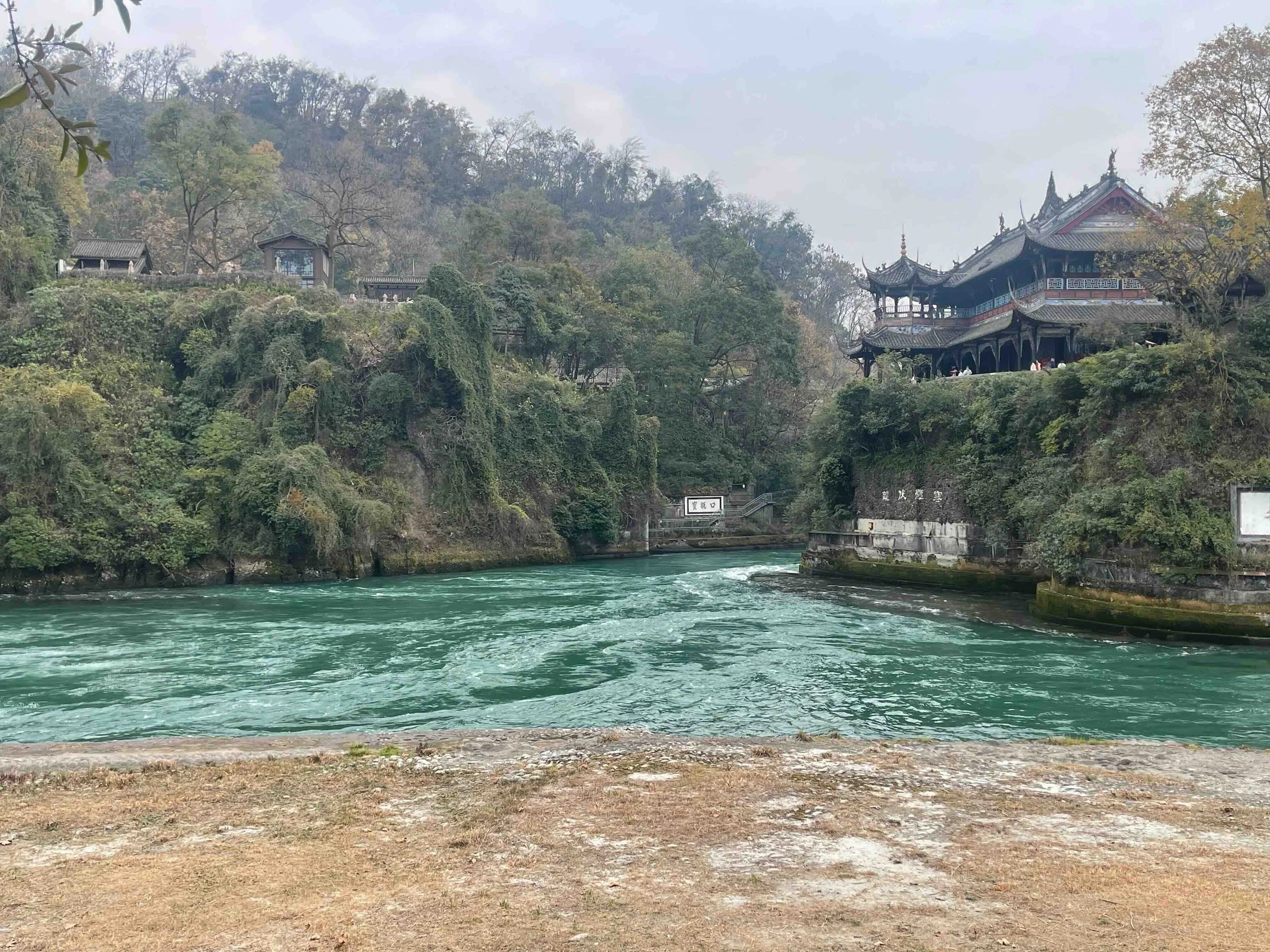
The channel at Dujiangyan known as the Bottle Neck (宝瓶口 )
There are three sections of the Dujiangyan system, and we hired a tour guide who took us to each section and explained each of them in detail. Because of the long walking distance from one section to another we took a ride on a passenger vehicle for part of the way. One of the most impressive things about this ancient water engineering project is that they were able to cut a channel through the mountain using a method of heating and cooling the stones in the mountain and breaking them down over a period of eight years (this was many centuries before the invention of dynamite in China). Aside from being a marvel of hydrology, this is a beautiful area to walk around in, and you can walk on paths along the rivers, across swinging rope bridges over the rivers, and on forested pathways up the hillside. There are also some temples to explore and other stories to learn about the area from more recent times.
Day Three: An Ancient Strategist and a Cherished Tang Poet
Having walked a great deal the previous day, we chose to take it easy the next morning, and it took us a while to get mobilized and out of the hotel. Around noontime we headed to Wuhou Ci 武侯祠 or the Shrine of Marquis Wu, a splendid temple and garden area. Wuhou Ci is a lovely place for a leisurely stroll and you can learn a thing or two about one of the most famous stories in Chinese literature and history. Marquis Wu was the honorary title given to the strategist Zhuge Liang, who plays a very important role in the story of the Three Kingdoms (三国 sanguo)as an adviser to Liu Bei 刘备, a major contender for the next emperorship after the decline and fall of the Han c. 200 AD.
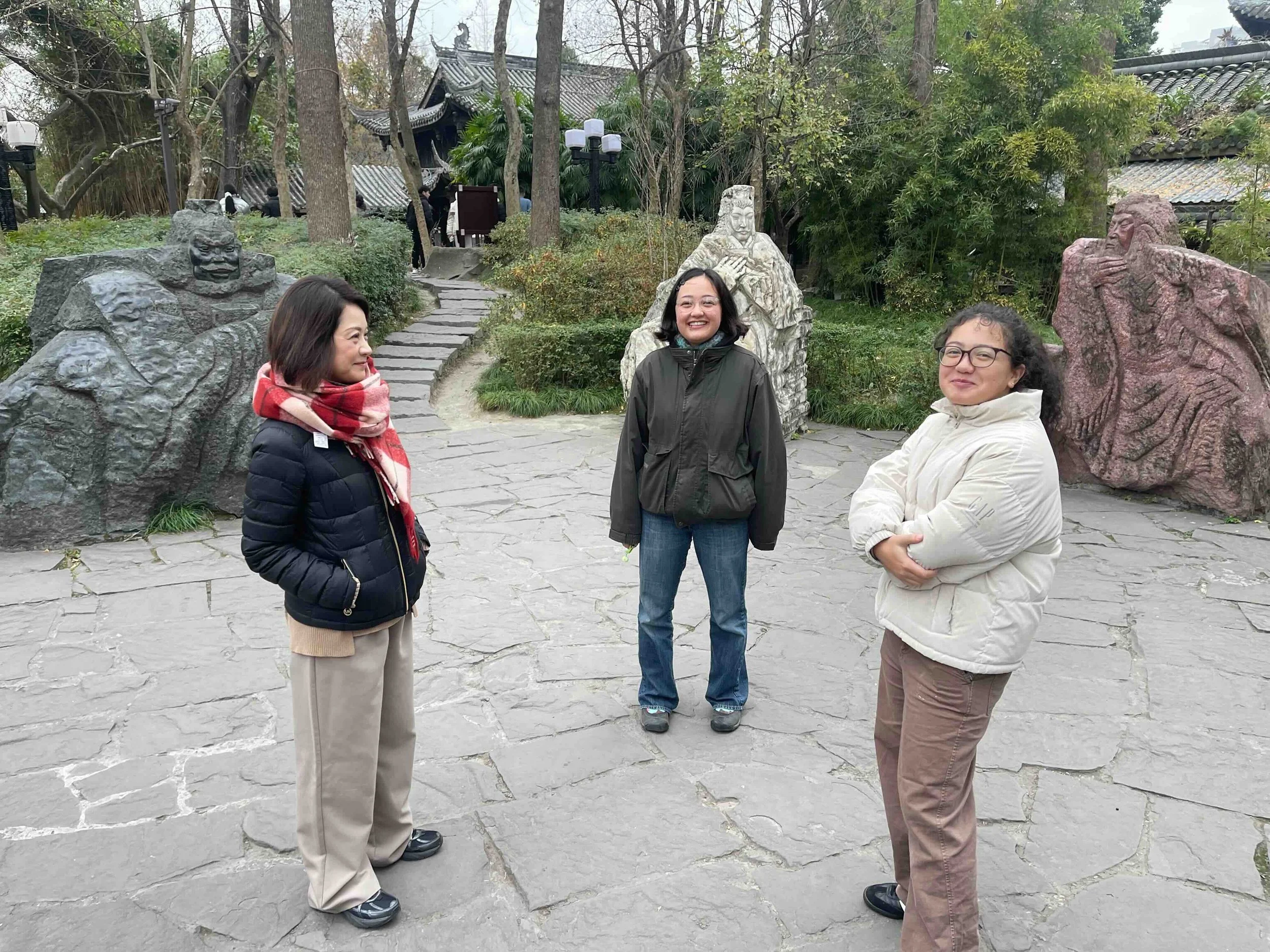
Posing with the three heroes of the Three Kingdoms: (l to r) Zhang Fei, Liu Bei, and Guan Yu
Wuhou Ci features a shrine dedicated to Zhuge Liang which is next to the original tomb mound of Liu Bei. There is also an area that commemorates the famous Peach Garden Oath, when the three heroes of the story, Liu Bei, Zhang Fei 张飞, and Guan Yu 关羽, first came together to pledge loyalty and mutual support for their noble cause. To be honest, I've never gotten my head completely around the Three Kingdoms story, which was passed down orally over the centuries and made into a sprawling novel in Ming era (c. 1500s) and has since been reproduced in countless plays, operas, and more recently, in films and TV series in China. The major figures are all well known to any schoolchild growing up in China. I advise taking one's time strolling around the area, as it is quite beautiful and full of gardens, grottoes and stories.
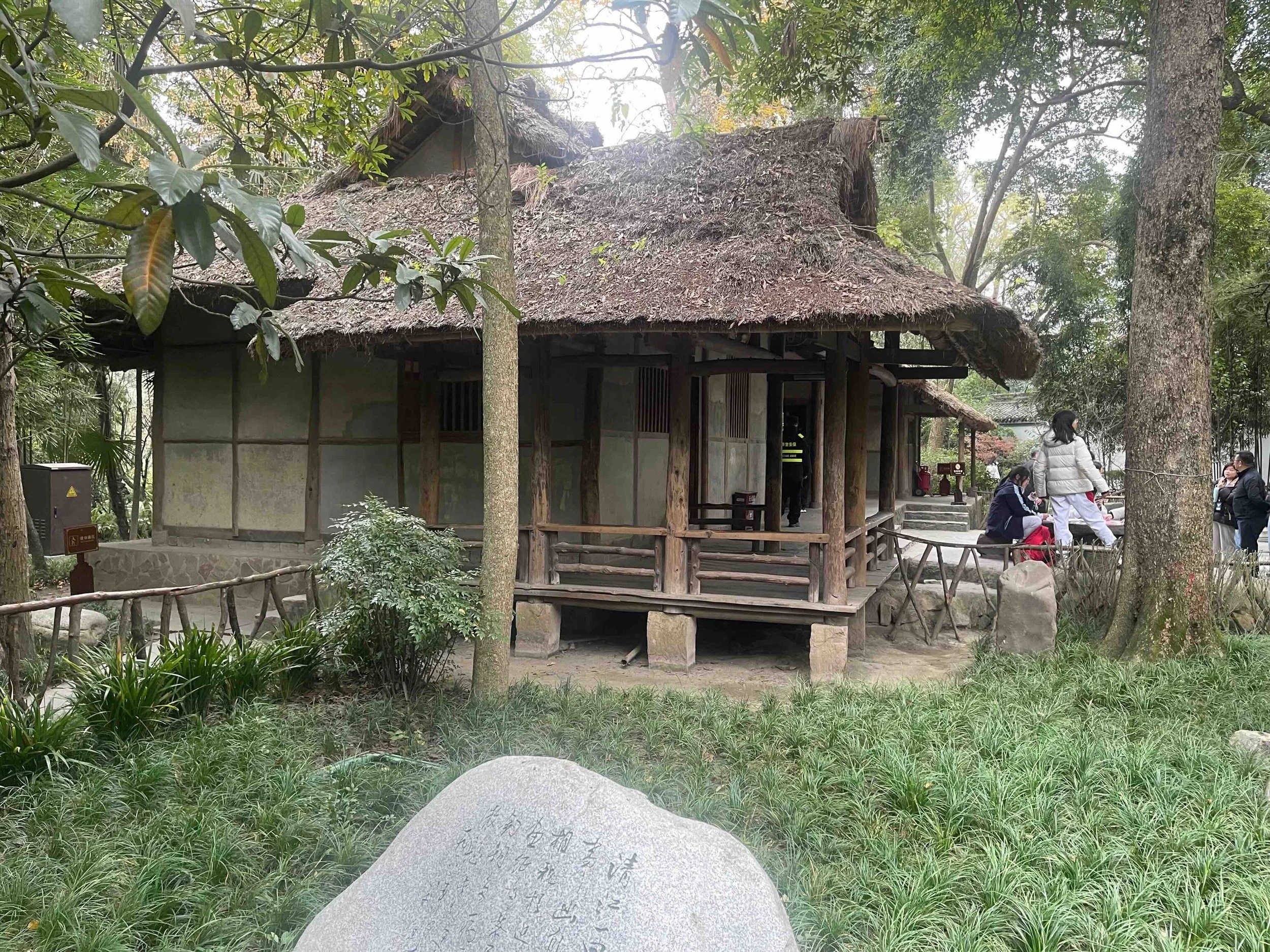
A representation of Du Fu’s Thatched Hut
Heading out, we emerged on Jinli 锦里 Snack Street, which is a very touristy spot with lots of food stalls, shops, eateries and tea houses, and plenty of "mask changing" performances. After stopping for tea at another outdoor teahouse and listening to a local lady singing Chinese pop songs, we then took another short cab ride to the famous site known as Du Fu's Thatched Hut (or Cottage) (杜甫草堂 Du Fu Cao Tang). This is an enclosed grounds with beautiful gardens, rockeries, bamboo groves, a waterfall, and architectural features. It was crowded with hundreds of uniformed students from the prestigious Renmin University Middle School (人大附中) in Beijing, who were obviously here on a heritage tour. Despite the crowds, we enjoyed a leisurely walk through the grounds, and we visited the cottage, or at least a facsimile thereof, where Du Fu spent three difficult years of hardship along with his family after being exiled from the capital of Xi'an during the An Lushan 安禄山 Rebellion of the 750s (Tang Dynasty era), and where he wrote some of his best poems. I've been a fan of Du Fu and his poetry ever since college, and this spot has been on my bucket list for many years, so it was nice to commune with the spirit of China's greatest poet in his temporary home.
After visiting this site for around 90 minutes, we took a cab back toward the city center and stopped at "Broad and Narrow Alleys" (宽窄巷 kuan zhai xiang), a renovated old area of town featuring lots of eateries and shops along wide and narrow alleys and a sea of tourists. We had some late afternoon snacks including dumplings and other goodies and then caught a cab back to our hotel for some rest. By the time everyone was ready to head out for dinner, it was late in the evening. Though it was Christmas Eve, we eschewed the fancy and expensive hotel buffet and headed out to explore the surrounding area. After walking around a neighborhood full of Japanese and Sichuan hotpot restaurants, we chose an unassuming hotpot place and had our Christmas dinner there in a relatively quiet environment with only a few other customers. After all the stimulation of the past two days was nice to unwind in a low-key environment. (One tip for hotpot eateries: Take advantage of the storage containers for clothing since they keep your jackets and outer wear from absorbing hotpot odors.)
Day Four: A Mysterious Collection of Archeological Treasures
Located in the countryside about an hour’s drive north-northeast of the city center, Sanxingdui 三星堆 is another must-see while visiting Chengdu. I've known about this archeological site for many years now and have included slides of artifacts such as the famous bronze statues and masks of alien-like human figures in my lectures on ancient China. I was happy to finally have a chance to visit the site and the museum that houses these incredible treasures excavated and painstakingly reconstructed in the twentieth century and even more recently. These mysterious artifacts represent a Sichuan-centered civilization that was distinctive yet connected to the major civilization of the Shang, centered around the Yellow River. For millennia, the traces of this ancient culture were lost to China and the world, until they were rediscovered in the 20th century in sacrificial pits with buried objects including bronze statues, masks, and numerous other artifacts, as well as elephant tusks.
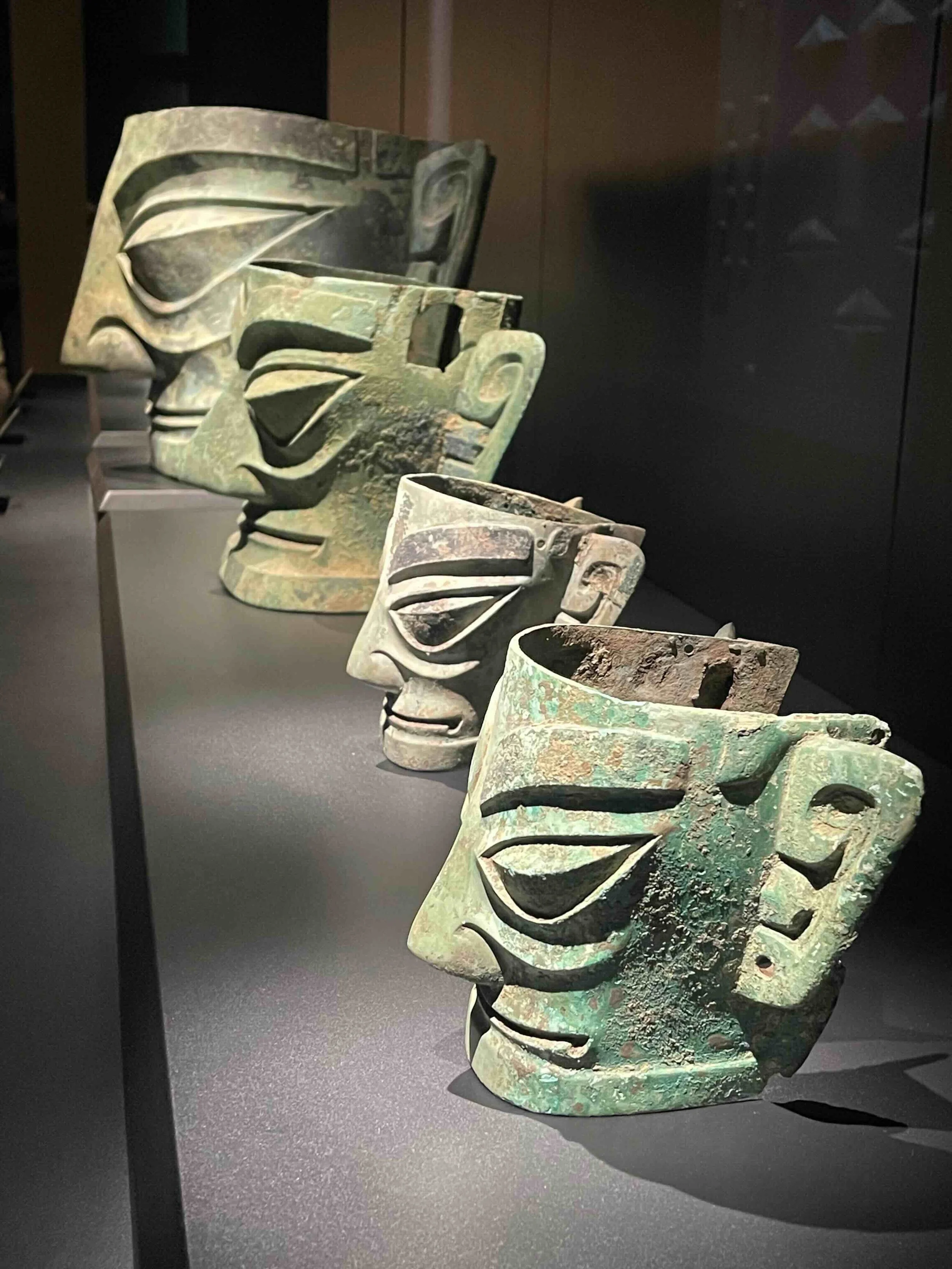
Masks in Sanxingdui Museum
The main museum, an impressive work of architecture, has two levels. The first level introduces the visitors to the history of the excavations in the 1920s, 1980s, and 2010s that led to these amazing discoveries, with plenty of photos, films, and information on the walls to guide the viewer into the collection. There are many ancient artifacts in glass cases on the first level, including bronze and gold masks, ritual daggers, pottery and bronze vessels, and other bronze and jade artifacts unearthed in the burial and sacrificial pits found in the nearby area. These artifacts are connected to Shang culture but are strikingly different to it as well. The most significant figure on the first floor is a two-meter-tall statue of a figure dressed in a ceremonial robe, whose hands seem to have held some sacred object, though nobody knows what it was for sure.
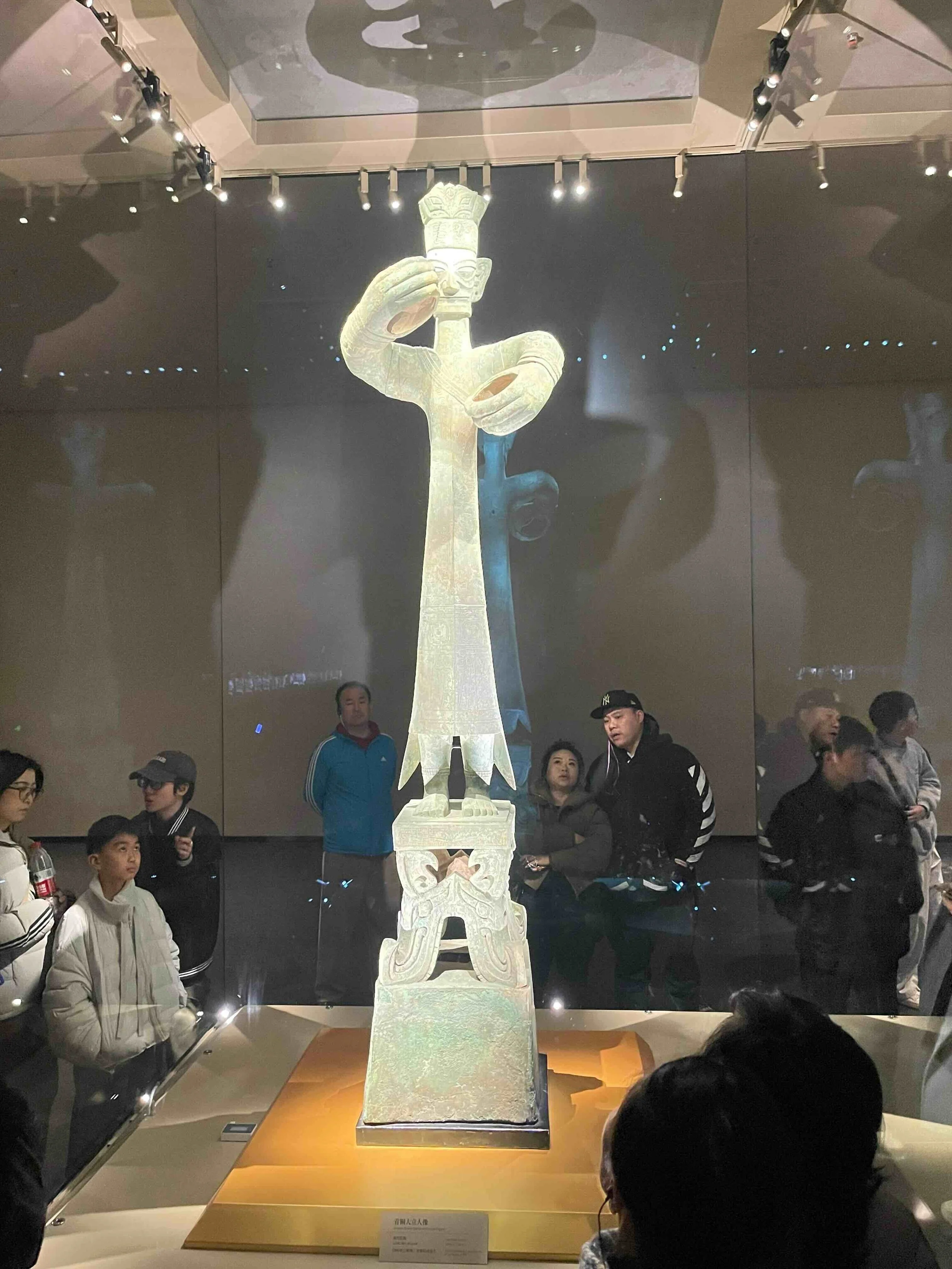
Statue on first floor of Sanxingdui Museum
On the second level of the museum are several rooms organized by different categories of artifacts representing the belief system of the people who made and buried these treasures well over three thousand years ago. Some are very intricately constructed towers and shrines depicting sacrificial and ceremonial rites. There are innumerable masks large and small, as well as many depictions of humans and animals such as birds and tigers.
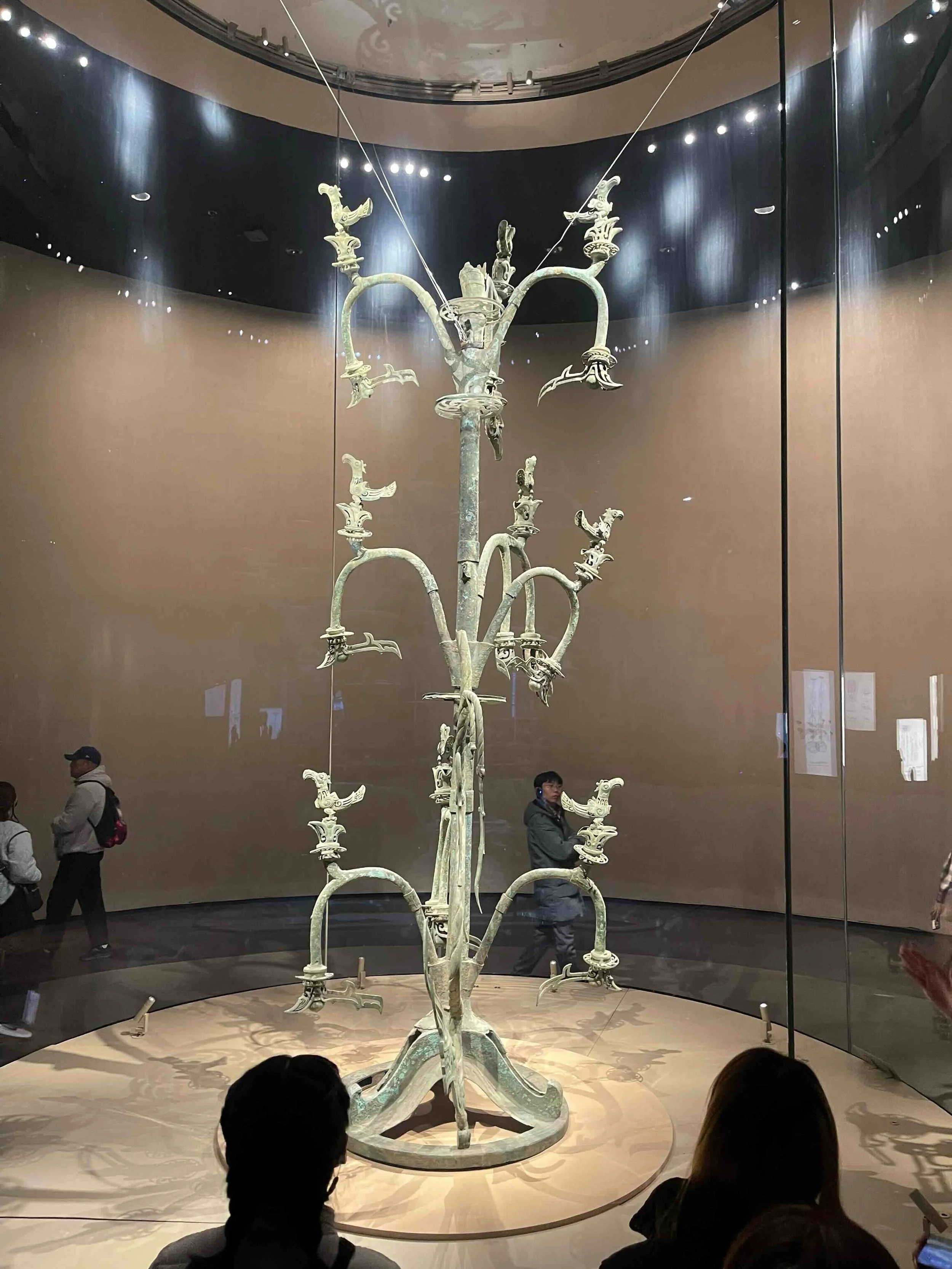
Tree on second level of Sanxingdui Museum
The most remarkable artifact on the second level is a tall bronze tree with nine birds perched on nine branches. Since there is no writing system or any evidence of writing associated with these finds, imagine the painstaking work that the archeologists had to do to reconstruct these artifacts and piece them together from buried and disintegrating fragments. And to this day, their meaning is still subject to interpretation. There are connections to Shang culture and civilization in the design and shapes of some of the vessels, and yet clearly this was a separate and distinctive civilization, and one that was eventually lost and forgotten for many millennia.
All told we spent around four hours on site, mostly in the main museum. Our driver then drove us an hour or so to Tianfu airport where we caught our flight back to Shanghai.
Reflections on a Trip Well Done
All in all, our four-day visit to Chengdu was jam-packed with adventures and discoveries, introducing us to sites and stories from several important dynastic periods in Chinese history, from the ancient Shang era circa 1500-1000 BC, to the Warring States/Qin era in the 200s BC, the end of Han in the 200s AD, the Tang in the 700s, and on to modern times. This is a city with many historical layers, one that was off the main track of Chinese civilization--as the famous poem by Li Bai goes, "The road to Shu (Sichuan) is hard"--but that was indeed connected to it in deep and significant ways. For our daughters, one in high school and one in college, who grew up in China, the trip offered a nice combination of adventure and education.
At street level, Chengdu itself seems like a fascinating city full of diverse peoples and busy neighborhoods, which we only caught glimpses of during our three days there. It would have been nice to get off the tourist track and experience more of the local urban culture, including the vibrant live music scenes, but I will have to leave this for my next visit. Also, we barely scratched the surface of the cuisine the city offers. Certainly, Chengdu is a city and a region of China that merits further exploration. And now we board our return flight to Shanghai with the thought of coming back for more educational adventures someday.